
LED Street Lighting Solutions: Design and Selection Guide
LED street lighting solutions combine efficient luminaires, precision optics, poles, electrical infrastructure and lighting controls into a complete roadway illumination system. They are used on urban roads, highways, residential streets, intersections, industrial access roads and other public spaces where reliable nighttime visibility is required.
A successful street lighting project involves more than selecting a luminaire by wattage. Road geometry, pole height, pole spacing, optical distribution, glare, uniformity, environmental exposure, control requirements and long-term maintenance must all be considered together.
This guide explains the main components, applications and design considerations that professional buyers should review when planning an LED street lighting project.
<!– IMAGE 1: Insert after the introduction | Visual: LED street lights illuminating an urban road with vehicles, sidewalks and a pedestrian crossing | Alt: “LED street lighting solutions for urban roads” | Source: company project photo / licensed stock / generated visual –>
What Are LED Street Lighting Solutions?
LED street lighting solutions are coordinated systems designed to provide appropriate nighttime visibility for motorists, cyclists and pedestrians.
A complete system can include:
- LED street light luminaires
- Optical lenses and light distributions
- Drivers and surge-protection devices
- Poles, brackets and mounting arms
- Power cables and distribution cabinets
- Photocells, timers or networked controls
- Photometric design and lighting calculations
- Installation, commissioning and maintenance support
The luminaire is only one part of the system. Even a high-quality LED street light may produce unsuitable results when its optical distribution, mounting height or output does not match the road.
Effective LED street lighting solutions therefore begin with the application and required lighting performance rather than a predetermined wattage or luminaire model.
Where LED Street Lighting Is Used
Urban arterial roads
Urban arterial roads often have multiple traffic lanes, intersections, bus stops, cycle lanes and pedestrian activity.
Lighting design must consider both the main carriageway and adjacent areas. Sidewalks, crossings, turning lanes and conflict points may require different optical distributions or mounting arrangements.
Pole positions must also coordinate with trees, traffic signs, signals, overhead cables and underground utilities.
Residential streets
Residential streets require a balance between visibility and neighborhood comfort.
The lighting system should help drivers and pedestrians see the road environment while limiting glare, light entering nearby homes and unnecessary upward light.
Suitable optics, reasonable output levels and controlled mounting angles are normally more useful than simply installing higher-wattage luminaires.
Highways and major roads
Highway lighting may be used at interchanges, ramps, toll areas, bridges, tunnels and other locations where additional nighttime visibility is required.
These projects may involve higher mounting positions, wider pole spacing and larger road areas. Wind loading, pole foundations, electrical distribution and safe maintenance access can significantly affect the final configuration.
Intersections and pedestrian crossings
Intersections contain multiple traffic movements and potential conflict points. Pedestrian crossings require drivers to detect people with enough time to respond.
Lighting at these locations should consider luminaire position, vertical visibility, background contrast and the transition between illuminated and darker areas.
Industrial parks and logistics areas
Industrial roads may carry trucks, forklifts, employee vehicles and pedestrians.
The lighting equipment may need additional protection against dust, moisture, vibration, corrosion or unstable power conditions. Entrances, loading zones, internal roads, parking areas and security checkpoints may require different lighting arrangements.
Public spaces and commercial districts
Street lighting in public squares, retail districts, parks and mixed-use developments must support visibility while complementing the surrounding architecture.
Decorative poles and luminaires can be used, but their optical and thermal performance should still satisfy the functional requirements of the project.
Main Components of LED Street Lighting Solutions
LED street light luminaires
The luminaire contains the LED modules, optical system, driver, housing, seals and thermal-management structure.
Important luminaire characteristics include:
- Luminous output
- Power consumption
- Optical distribution
- Color temperature
- Color rendering
- Glare control
- Driver efficiency
- Dimming compatibility
- Ingress protection
- Impact resistance
- Surge protection
- Corrosion resistance
- Lumen maintenance
- Ease of servicing
A luminaire should not be selected only by its wattage. Two LED street lights with the same wattage may produce very different roadway results because of differences in efficiency, optical distribution and installation geometry.
For this reason, buyers should evaluate photometric performance together with electrical and mechanical specifications.
Optical distribution
The optical system directs light from the LED modules onto the roadway and surrounding areas.
Different distributions may be required for narrow residential streets, wide multilane roads, intersections, sidewalks and parking areas.
An unsuitable optic can create excessive brightness directly below the pole while leaving dark sections between poles. It can also send unnecessary light behind the pole, into buildings or above the horizontal plane.
Optical selection should therefore be supported by a lighting calculation using the proposed luminaire’s photometric file.
LED driver
The driver regulates the power supplied to the LED modules.
Its electrical performance, operating temperature, surge protection and dimming compatibility can affect the reliability and controllability of the luminaire.
When dimming is required, confirm that the driver supports the specified control method. Common options include 0–10 V, DALI, DALI-2 and programmable standalone dimming.
Driver and controller compatibility should be tested rather than assumed. The U.S. Department of Energy has documented variation in the dimming behavior of market-available 0–10 V LED street lights. Review the DOE study.
Thermal management
LED modules and drivers generate heat during operation. The luminaire housing must transfer this heat away from sensitive components.
Thermal performance becomes particularly important in hot climates, enclosed installations or projects with long operating hours. Buyers should review the rated ambient temperature instead of evaluating the luminaire’s external shape alone.
Poles and mounting equipment
Pole height, spacing, setback, outreach and arrangement influence lighting performance.
Common pole arrangements include:
- Single-sided placement
- Opposite placement
- Staggered placement
- Median-mounted lighting
- Central high-mast lighting
The pole and bracket must also satisfy structural requirements for the local wind conditions, luminaire weight, projected area and mounting configuration.
Electrical infrastructure
The electrical system can include cables, distribution cabinets, breakers, contactors, grounding, surge protection and metering equipment.
Designers should consider voltage drop, circuit loading, protection coordination, cable routing, power quality and safe maintenance access.
For retrofit projects, existing cables and cabinets should be inspected before new luminaires are installed.
Lighting controls
Basic LED street lights may use photocells or time-based switching. More advanced systems can provide scheduled dimming, individual luminaire control, fault alarms and energy monitoring.
For projects requiring centralized management, buyers can connect the luminaires to a [smart street lighting system](/smart-street-lighting-solutions/).
Controls should address a defined operational requirement. Adding connected controllers without a clear monitoring and maintenance process can increase complexity without delivering useful operational value.
Key Street Lighting Design Criteria
Illuminance and luminance
Illuminance describes the amount of light reaching a surface. Luminance relates to the brightness perceived from that surface in a particular viewing direction.
The applicable design method depends on the road classification and local requirements. A professional lighting calculation may evaluate average values, minimum values, uniformity, glare and other performance criteria.
Uniformity
Uniformity shows how consistently the light is distributed across the evaluation area.
A road may have a high average lighting level while still containing uncomfortable bright spots and dark areas. Appropriate optics, pole spacing and mounting height are required to achieve a balanced result.
The Federal Highway Administration identifies uniformity as an important aspect of roadway-lighting quality alongside overall illumination. View FHWA roadway-lighting guidance.
Glare control
Excessive glare can reduce visual comfort and make objects more difficult to see.
Glare is influenced by:
- Luminaire intensity
- Optical distribution
- Mounting height
- Bracket angle
- Observer position
- Background brightness
- Road geometry
Increasing the light output does not necessarily improve visibility if glare is not controlled.
Color temperature
Color temperature affects the appearance of the road environment.
The selection should reflect local policy, road function, residential sensitivity, environmental objectives and the desired visual character. Higher color temperature should not automatically be interpreted as better visibility or better-quality lighting.
Light spill and upward light
Light directed outside the intended area can enter nearby properties, affect sensitive environments and contribute to sky glow.
Suitable optics, shielding, mounting positions, output levels and control schedules can reduce these effects.
The U.S. Department of Energy identifies reduced total output, limiting upward light and dimming during low-use hours as practical ways to address outdoor light-pollution concerns. Read the DOE guidance.
Maintenance factor
Lighting performance changes over time because of dirt accumulation, component aging and environmental exposure.
Lighting calculations should use an appropriate maintenance factor rather than assuming that the initial light output will remain unchanged throughout the system’s service life.
The maintenance factor should reflect the luminaire, local environment, cleaning schedule and planned maintenance practices.
How to Select LED Street Lighting Solutions
Professional buyers should compare proposed systems using measurable project requirements.
Start with the road
Collect information about:
- Road width
- Number of lanes
- Road classification
- Traffic volume
- Pedestrian activity
- Cycle lanes
- Intersections
- Pedestrian crossings
- Sidewalks
- Surrounding buildings
- Existing poles and power supplies
These conditions define the lighting problem that the system must solve.
Confirm applicable lighting requirements
Identify the standard, authority specification or project requirement that governs the design.
Do not use a lighting level taken from another project without confirming that its road classification, traffic conditions and evaluation method are relevant.
Review the photometric calculation
The supplier should prepare a calculation using the proposed luminaire, optic, output, pole height, spacing and mounting arrangement.
Review at least:
- Average lighting level
- Minimum lighting level
- Uniformity
- Glare
- Pole spacing
- Mounting height
- Luminaire tilt
- Calculation grid
- Maintenance factor
The calculation should represent the actual road geometry rather than a generic example.
Evaluate the complete luminaire specification
Compare the optical, electrical, mechanical and environmental specifications together.
A lower-wattage luminaire is not automatically more efficient if it fails to deliver the required lighting performance. Similarly, a higher lumen value does not prove that the light will be distributed effectively across the road.
Check maintenance requirements
Confirm which components can be replaced and whether drivers, controllers, surge-protection devices and optical parts are available separately.
Ask how the luminaire opens, whether tools are required, how power is disconnected during maintenance and what replacement parts will remain available.
Compare lifecycle requirements
Initial purchase price is only one part of the project cost.
Also consider:
- Installation
- Electrical work
- Control-system licensing
- Energy consumption
- Inspection
- Cleaning
- Replacement components
- Software support
- Warranty administration
- End-of-life replacement
The lowest equipment price may not produce the lowest operating cost.
Planning an LED Street Lighting Project
1. Conduct a site survey
Record road dimensions, pole positions, pole heights, spacing, mounting arrangements, power supplies, trees, buildings and existing equipment.
For retrofit projects, inspect existing poles, brackets, cables, cabinets and protection devices.
2. Define the lighting objectives
Identify the road users, operating conditions and areas that require illumination.
Separate requirements may be needed for the carriageway, sidewalk, cycle lane, crossing, parking area or intersection.
3. Develop a preliminary layout
Choose proposed pole positions, mounting heights, outreach dimensions and luminaire orientations.
Coordinate the layout with landscaping, drainage, traffic signs and underground services.
4. Complete photometric calculations
Use the proposed luminaire’s photometric file to calculate the expected performance.
Test alternative optics, outputs and pole arrangements before approving the design.
5. Select electrical and control systems
Define the supply voltage, circuits, protection, cabling, grounding, switching and dimming requirements.
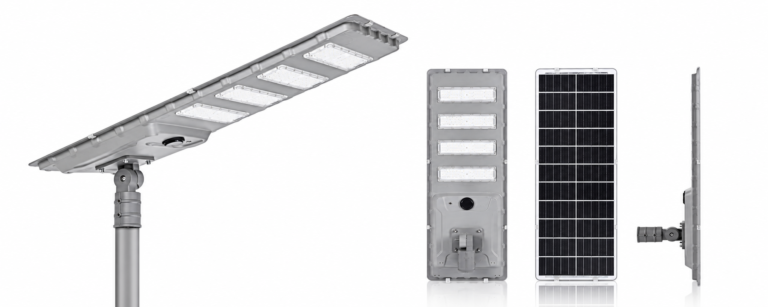
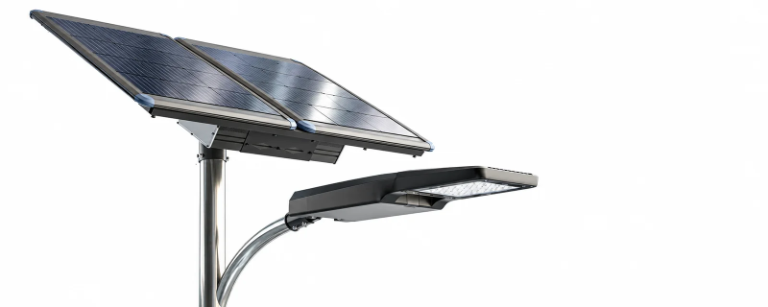
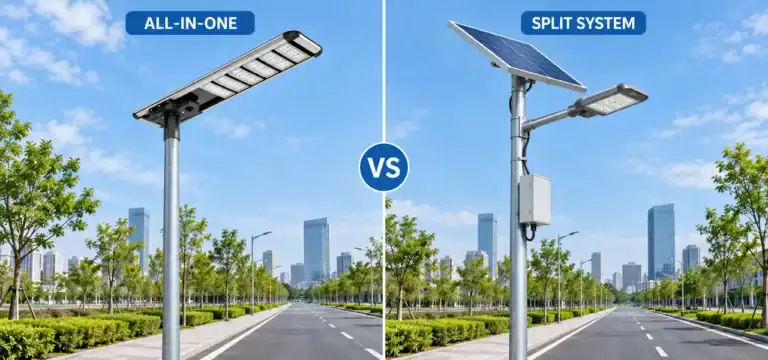
For off-grid locations, review whether [solar street lights](/solar-street-lights/) are more practical than extending the electrical network.
6. Review environmental conditions
Confirm exposure to rain, dust, high temperatures, salt spray, industrial pollution, strong wind, lightning, vibration and vandalism.
Product ratings should correspond to the actual environment.
7. Install and commission the system
Commissioning should verify:
- Luminaire model
- Optical code
- Mounting height
- Orientation
- Bracket angle
- Electrical safety
- Control operation
- Dimming response
- Field lighting performance
- Asset labels and project records
8. Prepare the maintenance plan
The project handover should include drawings, calculations, product data, configuration records, warranties, spare-parts recommendations and maintenance instructions.
<!– IMAGE 2: Insert after the planning section | Visual: Street lighting project process from site survey and photometric design to installation and maintenance | Alt: “LED street lighting solutions project planning process” | Source: original diagram / generated visual –>
Information to Include in a Supplier Inquiry
To receive an accurate proposal for LED street lighting solutions, provide:
- Project location
- Road type
- Road width and length
- Number of lanes
- Pole height
- Pole spacing
- Pole arrangement
- Existing luminaire information
- Required lighting criteria
- Operating hours
- Dimming requirements
- Input voltage
- Ambient temperature
- Environmental exposure
- Required protection ratings
- Quantity
- Project schedule
- Required reports or certifications
Road drawings, pole layouts, photographs and current lighting calculations can help the supplier prepare a more suitable recommendation.
Questions to Ask the Supplier
Before approving a proposal, ask:
- Which optical distribution is proposed?
- Why is the optic suitable for this road?
- Can the supplier provide the photometric file?
- Does the proposal include a project-specific lighting calculation?
- How are glare and uniformity controlled?
- Which driver and surge-protection device are included?
- Is the luminaire compatible with the required controls?
- Which components can be replaced?
- What commissioning documents are supplied?
- What warranty, spare-parts and technical support are available?
Conclusion
Selecting suitable LED street lighting solutions requires coordination between lighting performance, road geometry, electrical infrastructure, controls and maintenance.
Wattage alone cannot determine whether a luminaire is suitable for a road. Buyers should review optical distribution, photometric calculations, uniformity, glare, environmental protection and long-term service requirements before approving a system.
When requesting a proposal, provide the road layout, pole information, lighting criteria, control requirements and environmental conditions. These inputs allow the supplier to recommend a more accurate luminaire configuration and roadway-lighting design.
For project-specific LED street lighting solutions, send your road drawings, pole layout and lighting requirements to request a luminaire recommendation and photometric proposal.

Written by
sonycao1975@gmail.com
Solar energy specialist at Jinborui Electric Co., Ltd. -- delivering reliable photovoltaic solutions for government and engineering projects worldwide.
Leave a Reply