
All in Two Solar Street Light: Design, Components and Applications
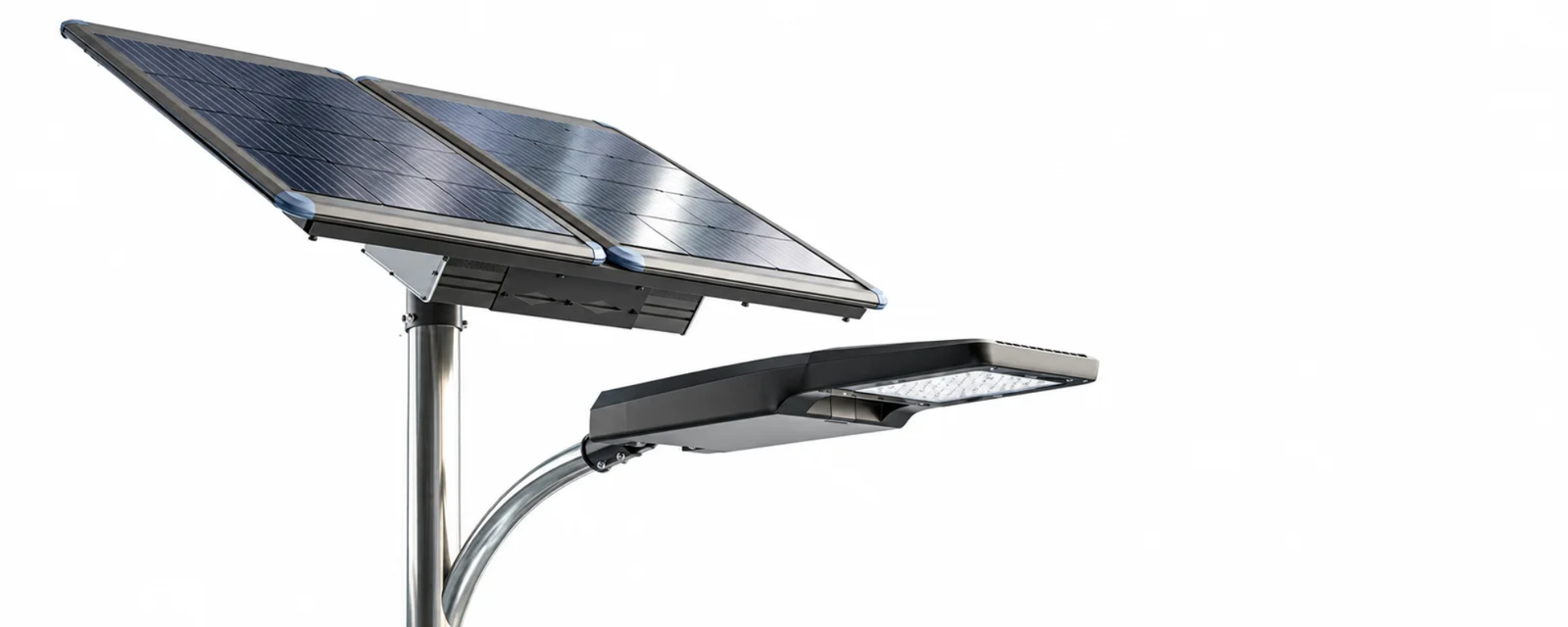
An all in two solar street light is a semi-integrated outdoor lighting system consisting of two main assemblies. The solar panel is installed separately, while the LED luminaire, battery and charge controller are normally combined in the lighting assembly.
This structure allows the solar panel to face the most suitable direction for collecting sunlight without forcing the luminaire to follow the same orientation. It also reduces the number of separately mounted components compared with a traditional split solar street light.
For road projects, the design provides a practical balance between installation simplicity and solar-energy flexibility. However, the panel, battery and lighting load must still be configured according to the installation location, operating schedule and required lighting performance.
<!– IMAGE 1: Insert after the introduction | Visual: An all-in-two solar street light installed beside a roadway, showing the separate solar panel and integrated lighting assembly | Alt: “all in two solar street light with separate solar panel” | Source: company product photo / licensed stock / generated visual –>
What Is an All in Two Solar Street Light?
An all in two solar street light divides the complete solar lighting system into two major parts:
- A separately mounted photovoltaic panel.
- A lighting assembly containing the LED module, battery and controller.
A cable connects the solar panel to the lighting assembly. During the day, the panel converts sunlight into electrical energy. The charge controller manages this energy and stores it in the battery. At night, the controller powers the LED module according to a programmed lighting schedule.
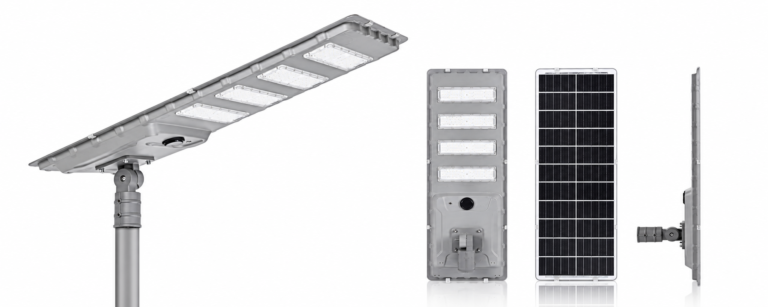
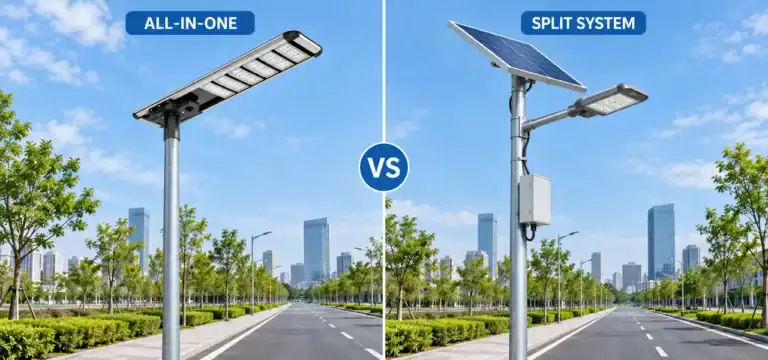
This architecture is also described as semi-integrated solar street lighting. It should not be confused with an all-in-one design, in which the solar panel is also incorporated into the luminaire housing.
Main Components of an All in Two Solar Street Light
Separate solar panel
The photovoltaic panel is mounted independently from the light head. Its angle and orientation can therefore be adjusted according to the available sunlight.
Independent placement is useful when the luminaire must face the road but the optimum solar orientation is in another direction. It may also allow a larger panel to be used than could be accommodated on the upper surface of an integrated luminaire.
The panel selection should consider:
- Local solar irradiation
- Seasonal weather conditions
- Panel orientation
- Installation angle
- Shading from trees and buildings
- Daily lighting energy demand
- Charging losses
- Required operating reserve
The panel should not be sized from luminaire wattage alone. Daily operating hours and dimming profiles affect the total amount of energy the system must produce.
LED lighting module
The LED module produces the required road illumination. Its wattage is only one specification.
Buyers should also evaluate:
- Luminous output
- Optical distribution
- Color temperature
- Glare control
- Lighting uniformity
- Thermal management
- Expected lumen maintenance
- Replaceability of the LED module
The optical distribution must match the road width, pole height, pole spacing and mounting arrangement. An unsuitable optic can produce excessive brightness below the pole while leaving darker areas between adjacent lights.
Battery
The battery stores energy generated during the day and supplies the LED lighting load at night.
In many semi-integrated designs, the battery is installed inside the luminaire housing or an attached compartment. This reduces the need for a separate ground-level or pole-mounted battery box.
Battery selection should account for:
- Daily energy consumption
- Maximum permitted depth of discharge
- Required autonomy
- Charge and discharge efficiency
- Ambient temperature
- Battery-management protection
- Expected cycling conditions
- Maintenance accessibility
Battery capacity should be expressed in usable energy terms. Comparing ampere-hours without checking the battery voltage can lead to an incorrect comparison.
Solar charge controller
The charge controller manages the energy flow between the photovoltaic panel, battery and LED load.
Its functions may include:
- Battery charging control
- Overcharge protection
- Over-discharge protection
- Load switching
- Time-based dimming
- Motion-sensor input
- Temperature-related protection
- System-status monitoring
Controller settings should match the battery chemistry and operating voltage. The lighting schedule must also correspond to the available solar-energy budget.
Sensor and control functions
An all in two solar street light may use a light sensor to detect day and night. Some systems also support motion sensing or scheduled dimming.
A typical profile might operate at a higher output during busy evening periods and reduce the output later at night. The exact profile must still maintain the required lighting performance for the application.
Motion sensing should be used carefully on roads. Sudden changes in output, detection distance, vehicle speed and interaction between adjacent luminaires should be considered during project planning.
Pole, bracket and cables
The pole and mounting structure support both the luminaire and the separate panel.
The structural design should account for:
- Luminaire weight
- Solar-panel weight
- Wind-exposed surface area
- Bracket length
- Panel angle
- Local wind conditions
- Pole material
- Foundation design
External cables and connectors must be suitable for outdoor installation. Cable routing should reduce exposure to water entry, abrasion, ultraviolet radiation and unauthorized access.
<!– IMAGE 2: Insert after “Pole, bracket and cables” | Visual: Exploded diagram identifying the separate panel, cable, LED module, battery, controller, bracket and pole | Alt: “components of a semi-integrated solar street lighting system” | Source: original diagram / generated visual –>
How an All in Two Solar Street Light Works
The operating process can be divided into four stages.
1. Solar-energy collection
During daylight hours, the photovoltaic panel generates electrical power. Output changes with solar intensity, panel temperature, orientation, dirt accumulation and shading.
2. Battery charging
The controller regulates the charging process and protects the battery from unsuitable operating conditions.
The amount of energy stored during the day must be sufficient for the planned nighttime lighting schedule and system losses.
3. Automatic nighttime operation
At dusk, the controller activates the LED luminaire. The system can operate at a fixed output or follow a programmed dimming profile.
4. Low-energy protection
If the battery reaches a low state of charge, the controller may reduce output or disconnect the load to protect the battery. The exact behavior depends on the controller configuration.
The National Renewable Energy Laboratory identifies nightly runtime, location, minimum light level, operating method and required days of autonomy as important inputs for sizing stand-alone photovoltaic lighting systems. Read the NREL photovoltaic lighting guide.
Advantages of the All-in-Two Architecture
Flexible panel orientation
The panel can face the direction that offers better solar exposure, while the luminaire remains aligned with the road.
This is one of the main reasons to consider an all in two solar street light for locations where the road direction and solar orientation do not match.
Greater panel-sizing flexibility
A separately mounted panel is not limited by the dimensions of the luminaire housing. This can provide more configuration flexibility for locations with lower solar resources or longer operating schedules.
Cleaner construction than a split system
The battery and controller are normally incorporated into the lighting assembly. This reduces the number of separate enclosures and mounting positions.
Reduced ground-level equipment
Integrating the battery into the lighting assembly removes the need for a separate ground-level battery cabinet in many designs. This can simplify the site layout and reduce access to the battery by unauthorized persons.
Easier component identification
The two-part architecture remains relatively easy for installers and maintenance teams to understand: one panel supplies one lighting assembly.
Limitations to Consider
External panel cable
The cable between the panel and luminaire must be installed correctly. Poor connectors, damaged insulation or unsuitable cable routing can affect charging performance.
Greater wind load
The independently mounted panel adds wind-exposed area to the pole. Structural calculations should consider the panel size, angle and bracket position.
Pole-top maintenance
When the battery is integrated into the luminaire, technicians may need lifting equipment to inspect or replace it.
Project-specific sizing is still required
The semi-integrated structure does not guarantee dusk-to-dawn operation under every condition. System performance depends on solar availability, battery capacity, lighting load, control profile and environmental conditions.
Shading risk
A panel that receives partial shading may generate substantially less energy than expected. Trees, buildings, utility poles and new construction should be evaluated during the site survey.
Suitable Applications
An all in two solar street light can be considered for:
- Urban and suburban roads
- Rural roads
- Residential developments
- Industrial parks
- Logistics areas
- Campus roads
- Parking areas
- Public walkways
- Remote access roads
- Locations without convenient grid power
It is especially relevant when the project needs independent solar-panel orientation but does not require the fully separated architecture of a traditional split system.
How to Specify the System
Professional buyers should provide the following project information:
- Project location
- Road width
- Road length
- Pole height
- Pole spacing
- Mounting arrangement
- Required lighting level
- Nightly operating hours
- Dimming schedule
- Required autonomy
- Seasonal weather conditions
- Shading conditions
- Ambient-temperature range
- Local wind requirements
- Quantity
- Installation schedule
The supplier should use these inputs to configure the panel, battery, LED load, controller and optical distribution.
Questions to Ask the Supplier
Before ordering an all in two solar street light, ask:
- What is integrated into the luminaire housing?
- What are the solar-panel rated power and dimensions?
- What is the battery voltage and usable energy capacity?
- Which battery chemistry is used?
- What charging and load protections are included?
- Can the dimming schedule be programmed?
- Which optical distribution is supplied?
- Can the supplier provide a photometric calculation?
- How is the external cable protected?
- Can the battery, controller and LED module be replaced?
- What wind-load information is available?
- Which installation and maintenance documents are included?
Conclusion
An all in two solar street light separates the photovoltaic panel from the lighting assembly while integrating the LED module, battery and controller into a coordinated unit.
Its main advantage is the ability to orient and size the solar panel independently from the luminaire. This makes the architecture useful for projects that need more solar flexibility than an all-in-one design while retaining fewer external components than a traditional split system.
For a project-specific proposal, provide the road dimensions, pole layout, required lighting performance, operating schedule and installation location. These inputs are necessary to configure the solar panel, battery, luminaire and controller as one complete system.

Written by
sonycao1975@gmail.com
Solar energy specialist at Jinborui Electric Co., Ltd. -- delivering reliable photovoltaic solutions for government and engineering projects worldwide.
Leave a Reply