
Smart LED Street Light Control System
For Gov Projects
Jinborui Introduce a new generation of intelligent street lamps, featuring integrated Internet of Things control, adaptive dimming and centralized cloud management functions, specifically designed for municipal departments of multiple countries, EPC contractors and the deployment of smart city infrastructure.

70%
Energy Saved
200+
Gov Projects
Smart Street Light Solutions
Delivering a full portfolio of Smart Street Lighting products engineered for government‑led, municipal and smart‑city projects across the globe.

Smart Led Street Light System Overview
The Smart Street Lighting system combines LED lighting, sensors and IoT control for intelligent urban lighting management with real‑time monitoring and automation.

Smart Led Street Light Control System Model Selection Guide
Each model within the Smart Street Lighting control system is purpose‑built for highways, municipal roads and industrial areas, supporting a wide range of power levels, control options and installation structures.

Smart Street Light Controller Technology
Designed for Smart Street Lighting, this smart street light controller realizes remote dimming, scheduling, fault detection and energy optimization through IoT‑based communication systems.

Smart Led Street Light System Using Arduino for IoT Learning
This Arduino‑powered system for IoT learning simulates real‑world smart city automation concepts for Smart Street Lighting, ideal for education and research environments.

Smart Street Lighting Control System System Project Report
The project report of Smart Street Lighting Control System offers system design, cost analysis, energy‑saving data and implementation roadmap for Smart LED Street Lighting, targeting government and EPC contractors.

Benefits of Smart Street Light Systems in Real Projects
Smart Street Light Systems help municipalities and highways save energy, boost safety and minimize maintenance costs. Capable of integrating LED displays, environment monitoring, one‑touch alarm, charging piles and cameras, they act as multi‑purpose smart city nodes.

Government Grade 5G IoT Smart Street Light
The industrial‑grade 5G IoT Smart Street Lighting is built for government urban infrastructure projects, supporting stable 4G/5G dual‑network communication, precise intelligent dimming and full data traceability, and compatible with municipal smart city management platforms.

Smart Street Light Control System Using Arduino for Prototype Development
Developers leverage Arduino to build low-cost prototypes for the smart street light control system, incorporating LDR, PIR sensors and wireless communication modules for function validation.

Complete Smart Street Light System Project Design
Our full smart LED street light system comprises pole structure, LED luminaire, optional solar panel, controller and cloud‑based monitoring platform. Custom product appearance, tailored control systems, dedicated server architecture and OEM services are all offered for your projects.

Smart LED street lighting project employs optical fiber communication.
This smart LED street lighting project adopts optical fiber communication to realize reliable inter-device connectivity. It supports motion detection, automatic light switching and full-featured IoT control, making it ideal for real-world smart city deployment beyond simple prototype testing.
Need a custom smart street light solution or OEM/ODM partnership? Our engineering team is ready to assist.
What is an IoT smart led street light ?
An IoT smart led street light is an intelligent outdoor lighting device integrated with LED luminaires and wireless communication modules (NB-loT, LoRa, or 4G). All device data and lighting logic are managed through the unified smart street light control system, enabling each fixture to be individually monitored, dimmed, scheduled and controlled via a centralized cloud CMS platform.
JINBORUI's matched smart led street light and supporting smart street light control system are purpose-built for large-scale government and infrastructure projects, offering seamless integration with global smart city platforms and full OEM/ODM customization.
Remote Control
Control every light from a single dashboard, anywhere in the world.
Energy Analytics
Real-time consumption data and automated reporting for cost control.
Fault Detection
Instant alerts for lamp failures, reducing maintenance response time.
Smart Dimming
Schedule-based or sensor-triggered dimming for maximum efficiency.
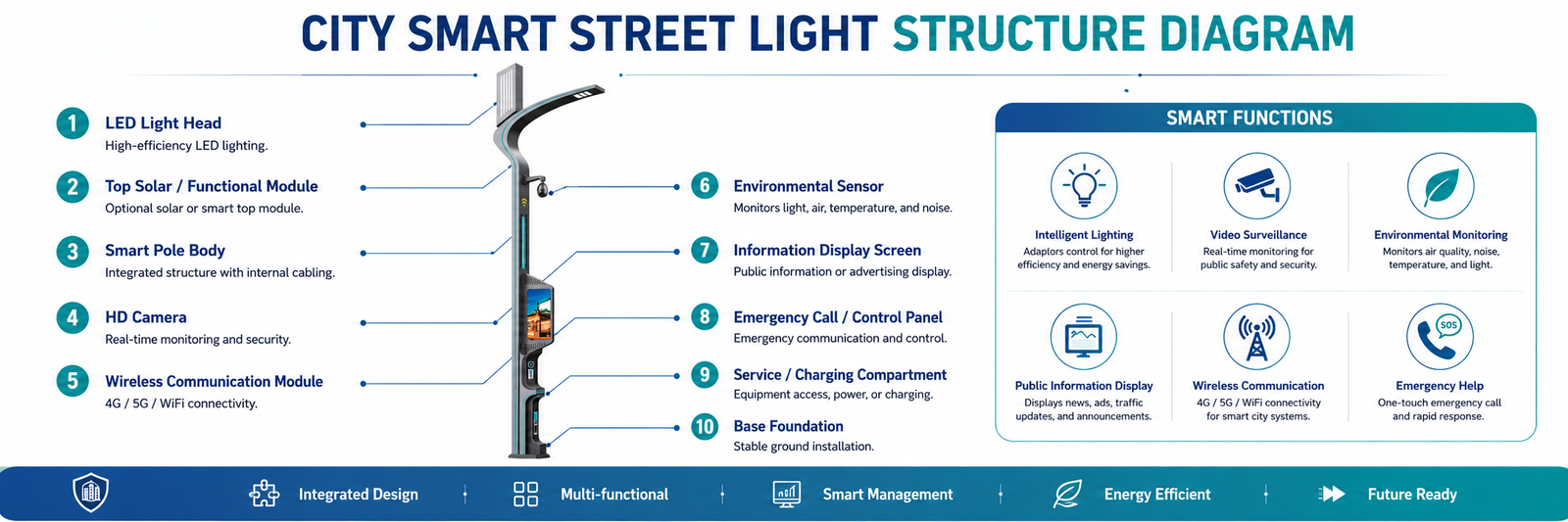
IoT smart led street light System Components
A complete end-to-end intelligent lighting ecosystem of smart led street light and supporting smart street light control system -- from single luminaire hardware to cloud management terminal.
Core Hardware
High-efficacy smart led street light luminaire (≥150 lm/W) with integrated surge protection, IP66/IP67 rating, and IK10 impact resistance. Power range covers 30W-300W to match all road scenarios.
Local Control Unit
Single-lamp controller installed in each smart led street light housing, a core hardware part of the whole smart street light control system. It measures voltage, current, power, and lamp status, supports OTA firmware updates and remote parameter configuration.
Communication Module
Low-power wide-area communication module for the whole smart street light control system. NB-loT leverages existing cellular networks; LoRa provides private network deployment for suburban areas with limited signal coverage.
Cloud CMS Platform
Browser-based cloud management terminal of the smart street light control system, equipped with GIS map view, group control for bulk smart led street light, energy statistics, alarm management, and open API integration for third-party smart city systems.
Proven Advantages of Intelligent Street Lighting Systems
Energy Saving up to 70%
Smart dimming and scheduling eliminate unnecessary energy consumption during low-traffic hours, delivering measurable ROI within 2-3 years.
Centralized Control at Scale
Manage thousands of street lights across an entire city from a single operator dashboard, reducing the need for field inspection teams.
Lower Maintenance Cost
Proactive fault alerts and predictive maintenance data reduce unplanned outages and lower the total cost of ownership over the product lifecycle.
Real-time Monitoring & Reporting
Automated energy reports and compliance documentation support government auditing requirements and carbon-reduction reporting obligations.
70%
Energy Reduction
3yr
Avg. ROI Period
50k+
Units Deployed
30+
Countries Served
Technical Specifications
Full specification data for engineering teams, tender documents, and procurement evaluation.
Luminaire Specifications
IoT Controller & Communication
Frequently Asked Questions
Frequently‑raised questions from engineers, procurement teams and government clients regarding IoT‑enabled Smart LED Street Lighting systems.
What is IoT‑based Smart Street Lighting, and what sets it apart from traditional street lamps?
Each smart street‑lighting fixture combines a standard LED luminaire with a built‑in IoT controller and wireless communication module. Unlike conventional street lights that only support basic on‑off switching, smart lamps establish real‑time connections with cloud‑based management platforms. They deliver practical capabilities such as remote switching, adaptive dimming, energy‑use metering and automatic fault detection. This transforms static lighting hardware into a dynamic, data‑powered network, cutting operational expenses while improving overall service quality.
How does an IoT‑powered Smart Street Lighting system work?
Each luminaire in the system is equipped with an IoT controller. The device gathers operational data such as voltage, current, power factor and lamp working status, and transmits information to the cloud management platform (CMS) via NB‑IoT, LoRa or 4G networks. The CMS processes received data and allows operators to issue instructions for individual lamps or entire lighting zones, such as setting dimming timetables, performing group on‑off control and triggering emergency overrides. When system anomalies are detected, fault alerts will be automatically sent out to maintenance crews.Each luminaire in the system is equipped with an IoT controller. The device gathers operational data such as voltage, current, power factor and lamp working status, and transmits information to the cloud management platform (CMS) via NB‑IoT, LoRa or 4G networks. The CMS processes received data and allows operators to issue instructions for individual lamps or entire lighting zones, such as setting dimming timetables, performing group on‑off control and triggering emergency overrides. When system anomalies are detected, fault alerts will be automatically sent out to maintenance crews.
What energy‑saving advantages does street‑level LED lighting provide?
When compared with conventional high‑pressure sodium (HPS) lamps, modern LED road lighting can reduce energy consumption by up to 70%. This saving comes from three main factors. Firstly, LED technology delivers 50‑60% higher energy efficiency than HPS lamps. Secondly, adaptive dimming lowers brightness during periods of low traffic, typically from 11 p.m. to 5 a.m. Thirdly, remote oversight prevents unnecessary full‑power operation or accidental light activation when reduced brightness is adequate. With automatically generated reports, city authorities can accurately compute carbon‑reduction data to meet official sustainability targets.
Which communication protocol works best for road‑light management: NB‑IoT, LoRa, or 4G?
The optimal communication option depends on actual field deployment environments. NB‑IoT delivers strong performance in areas with stable cellular coverage, with low costs per end‑device and the ability to leverage existing network infrastructure. LoRa fits locations with weak mobile‑network signals, supporting private network deployment whereby a single gateway can handle thousands of connected end‑points. 4G LTE is ideal for projects requiring large data throughput, real‑time video streams and multi‑sensor data convergence. Jinborui supports all three communication options and can assist you in identifying the most appropriate solution based on local site conditions and budget limits.
Can Jinborui deliver OEM / ODM custom‑built road lighting units?
Yes. Jinborui provides complete OEM and ODM customization for connected road lighting hardware. Customizable items include fixture casing design, power rating, communication interfaces, colour temperature, optical performance, pole mounting adaptability and brand labelling. Our engineering team collaborates closely with contractors and distributors to build solutions tailored to individual projects. MOQ requirements are applicable. Please reach out to our sales team for further information regarding production lead‑times and mould‑related expenses.
What certifications do Jinborui connected road‑lighting hardware and its management platform hold?
Jinborui connected road‑lighting units and their matching management platform carry CE marking and meet RoHS requirements, while production follows ISO 9001 quality‑management standards. The lighting fixtures achieve IP66/IP67 ingress‑protection ratings and comply with IK10 impact‑resistance specifications. Further accreditations including ENEC, SAA, UL and CB may be obtained for both hardware and platform based on destination‑market needs. Complete test documentation is available to support bidding and tender submissions.
Request Custom Quote for Connected LED Road‑Lighting & Full Management‑System Project
Provide unit count, location, protocol, power and functional requirements. Our engineering team replies within 24 hours with custom lighting & system proposals.
24-Hour Response
Our engineering team reviews every inquiry and responds with a tailored proposal.
Free Lighting Simulation
DIALux lighting design report included for qualified projects at no charge.
Full Tender Documentation
BOQ, technical specs, and compliance certificates ready for procurement submission.