
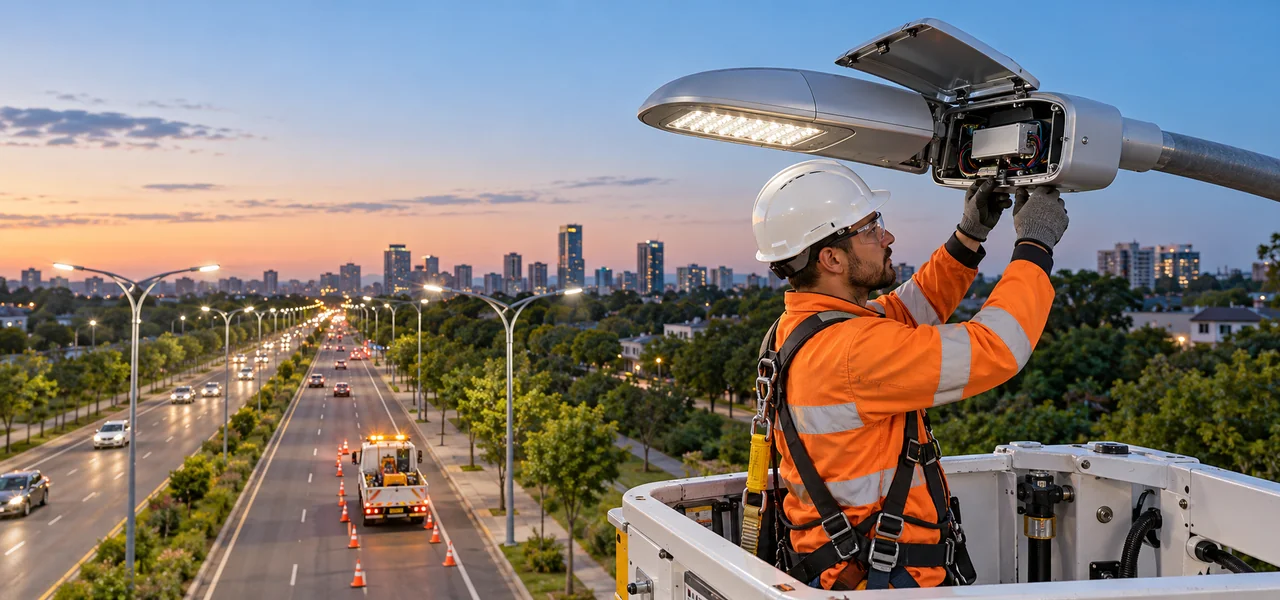
LED Street Light Troubleshooting: Common Problems, Causes, and Solutions
LED street light troubleshooting starts with the complete roadway lighting system: the luminaire, driver, surge protection, photocell or controller, supply circuit, connectors, grounding, pole wiring, mounting hardware, and central management platform where applicable. When a road becomes dark, uneven, or unreliable, the LED module is only one possible cause.
For municipal authorities, utilities, EPC contractors, and maintenance companies, effective LED street light troubleshooting identifies the failure pattern before replacing parts. One dark luminaire, a whole feeder outage, repeated failures after storms, and a light that cycles at dusk require different checks and different remedies.
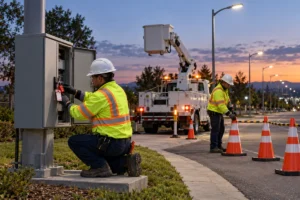
Immediate safety check: never open or test an energized street light. Isolate the circuit, apply the required lockout procedure, verify absence of voltage, and use qualified personnel for electrical testing or work at height. Keep the pole or circuit out of service if there is arcing, smoke, a burning smell, exposed conductors, water inside energized equipment, repeated breaker operation, a loose luminaire, a damaged pole, or unstable mounting hardware. Secure the road area when a fault could endanger traffic, pedestrians, or the maintenance crew.
LED Street Light Troubleshooting Table
| Symptom or field sign | Likely causes | First diagnostic check | Proportionate remedy |
|---|---|---|---|
| One street light is completely off | Loss of power at the pole, photocell fault, failed surge protective device, driver fault, loose connector, or LED module fault | Confirm whether nearby lights operate and whether power reaches the isolated luminaire | Repair the supply or connection, test the control and protection components, then replace only the confirmed failed part |
| Several consecutive lights are off | Feeder, cabinet, breaker, contactor, cable, communication, or group-control fault | Check the affected boundaries and cabinet alarms | Restore the upstream circuit or control system before replacing luminaires |
| A light switches on and off repeatedly at dusk | Photocell sees reflected light, photocell fault, unstable supply, thermal protection, or loose connection | Observe the timing and check whether the problem follows the control device | Correct sensor position or compatibility, repair the circuit, or replace the confirmed faulty component |
| One luminaire flickers | Driver degradation, loose connector, water ingress, local control fault, or LED board problem | Compare the fixture with adjacent units and inspect after safe isolation | Correct the connection or sealing problem; test the driver and LED module separately |
| A group flickers together | Supply fluctuation, shared neutral or splice fault, cabinet control problem, or incompatible dimming command | Check whether the affected fixtures share a feeder or control group | Diagnose the upstream electrical or control problem |
| Road surface is dim or uneven | Dirty lens, wrong optic, incorrect tilt, reduced driver output, lumen depreciation, excessive spacing, or wrong mounting height | Measure an illuminance grid and compare the installed model with the approved design | Clean, re-aim, recommission, revise the optic, or redesign the layout as indicated |
| Failures increase after storms | Surge exposure, damaged SPD, grounding issue, cable fault, or water ingress | Review failure locations, SPD condition, grounding, and enclosure seals | Correct protection and ingress causes before installing replacement components |
| Condensation or corrosion is visible | Damaged gasket, loose gland, cracked housing, incorrect installation orientation, or unsuitable environmental resistance | Inspect water paths and affected components after isolation | Replace damaged seals and compromised electrical parts; correct the installation |
| Smart street lights ignore commands | Controller power loss, communication failure, address or configuration error, driver-interface mismatch, or platform fault | Separate local luminaire operation from network operation | Restore local power or wiring, recommission the node, or correct the network and software configuration |
| Brightness or color differs between poles | Mixed product versions, incorrect driver setting, optical contamination, thermal stress, or aging | Check model, batch, driver setting, CCT, lens condition, and operating temperature | Correct configuration, clean, or replace matched components after confirming the cause |
1. LED Street Light Troubleshooting for a Light That Does Not Turn On
A single dark light does not automatically mean that the complete luminaire has failed. In this LED street light troubleshooting scenario, the fault may be at the pole base, fuse or protective device, photocell, surge protector, driver, connector, or LED module.
How to narrow the cause
Start by confirming whether the fault affects only one pole. Review the central management system or feeder cabinet if the project has remote monitoring. After the circuit has been isolated, qualified personnel can check:
- Supply conductors and terminals at the pole base.
- Fuse, breaker, contactor, and local protective components.
- Photocell, shorting cap, timer, or node output.
- Surge protective device status.
- Driver input and output against the approved product data.
- Connectors between the driver and LED module.
- Signs of overheating, corrosion, water ingress, or damaged LEDs.
The checking order should follow the product wiring diagram. Do not bypass protection or control components as a permanent repair. Temporary diagnostic substitutions should only be performed by qualified personnel using approved components and procedures.
Corrective action
Repair the upstream supply or connection when power is not reaching the luminaire. If the input is correct but the driver has no compliant output, replace it with the exact approved model or a manufacturer-confirmed equivalent. If the driver operates correctly but the LED module remains dark, inspect the module and internal connections before deciding whether module or luminaire replacement is more practical.
2. LED Street Light Troubleshooting for a Group Outage
When multiple adjacent luminaires are off, LED street light troubleshooting should begin with the shared infrastructure. Replacing individual fixtures before checking the feeder can waste parts and leave the real problem unresolved.
Diagnostic clues
- The dark section begins and ends at cabinet, branch, or phase boundaries.
- Several lights failed at the same time.
- The management platform reports a cabinet, contactor, gateway, or communication alarm.
- The fault appeared after excavation, flooding, roadworks, or a storm.
- All affected lights follow the same switching or dimming schedule.
Corrective action
Inspect the distribution cabinet, protective devices, contactors, underground or overhead cable, branch connections, neutral, grounding, and group controller. For networked systems, confirm whether the local lighting output is healthy before investigating communications. A loss of monitoring does not always mean a loss of power, and a successful remote command does not prove that the luminaire actually switched.
Record the feeder, phase, pole numbers, and time of failure. This turns a vague complaint into a traceable circuit or control issue.
3. LED Street Light Troubleshooting for Flicker and Cycling
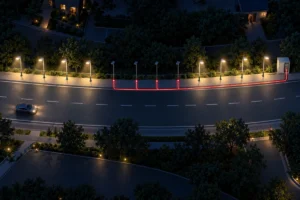
The timing and scale of flicker provide important LED street light troubleshooting evidence.
One fixture flickers
A local driver, connector, photocell, control node, LED module, or moisture problem is more likely when adjacent lights are stable. Note whether the flicker begins immediately, after warm-up, during rain, or only at dusk.
A whole group flickers
If several lights on the same feeder flicker together, investigate supply fluctuation, a loose shared connection, contactor behavior, control commands, or phase and neutral problems. Check whether pumps, industrial loads, or switching events coincide with the symptom.
A light cycles at dusk
A photocell can switch a lamp on, detect light reflected from the road, luminaire, sign, wall, tree, or nearby fixture, and then switch it off again. The cycle repeats as the area becomes dark. A faulty or incompatible photocell can create a similar symptom.
Corrective action
Confirm photocell orientation and exposure before replacing it. Check the control device’s voltage class, receptacle, switching function, and compatibility with the luminaire. For driver or supply-related flicker, qualified personnel should inspect the input waveform, connections, driver, and control signal. Stop using the affected circuit if flicker is accompanied by arcing, heat, odor, or repeated protective-device operation.
4. LED Street Light Troubleshooting for Dark or Uneven Roads
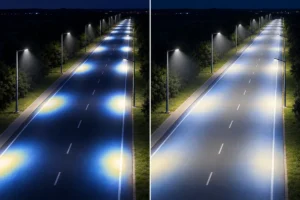
A functioning LED street light can still produce an unacceptable road-lighting result. In this stage of LED street light troubleshooting, low average illuminance, poor uniformity, dark pedestrian zones, excessive glare, or weak vertical illumination may point to product selection, layout, aiming, commissioning, dirt, or component degradation.
Confirm the actual symptom
Measure an illuminance grid using the required roadway geometry and measurement method. Review average and minimum values, uniformity, pole spacing, mounting height, outreach, tilt, road width, lane arrangement, median, sidewalks, and surrounding obstructions. Compare the installed product code and optic with the approved photometric file.
Common findings include:
- The installed optic differs from the design optic.
- The luminaire tilt or bracket position changed during installation.
- Trees, signs, cables, or new construction block the distribution.
- Dirt, dust, insects, or lens aging reduce delivered light.
- A driver setting or dimming schedule limits output.
- A one-for-one retrofit retained a pole layout designed for a different light source.
Corrective action
Clean the luminaire using the approved method and confirm the programmed output first. Correct aiming or bracket alignment when the installed position is wrong. If the layout or optic is unsuitable, revise the photometric calculation rather than increasing wattage across the entire road. Higher output can increase glare and energy consumption without correcting uniformity.
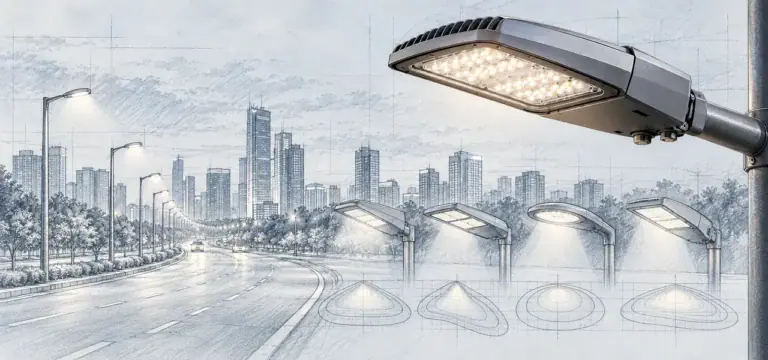
Jinborui’s LED street light range includes roadway luminaire configurations with project-specific wattage, optics, color temperature, controls, and housing options. The exact model should be selected through the road geometry and required lighting performance rather than nominal wattage alone.
5. LED Street Light Troubleshooting for Repeated Driver Failures
Repeated driver replacement is not a complete LED street light troubleshooting solution if the cause is surge exposure, unstable voltage, heat, moisture, grounding, or incorrect component matching.
Build a failure pattern
Record the pole ID, luminaire model, driver and SPD model, production batch, installation date, feeder, failure date, weather event, symptom, and replaced component. Map the failures along the road.
Useful patterns include:
- Failures concentrated near exposed intersections, hilltops, or long overhead feeders.
- Several components damaged after thunderstorms or switching events.
- Failures limited to one cabinet, phase, or branch.
- Drivers failing inside luminaires that also show moisture or corrosion.
- Failures occurring in high-temperature enclosures or blocked heat sinks.
Corrective action
Have a qualified engineer review the actual supply, surge environment, grounding and bonding, protection coordination, cable condition, driver input range, thermal conditions, and enclosure integrity. Replace damaged surge protection and drivers only after the system cause has been addressed. Match replacement components to the approved electrical, thermal, control, and enclosure requirements.
Do not assume that a higher surge-protection number alone guarantees reliability. The complete protection path, grounding arrangement, device location, installation, and exposure conditions all matter.
6. LED Street Light Troubleshooting for Water and Corrosion
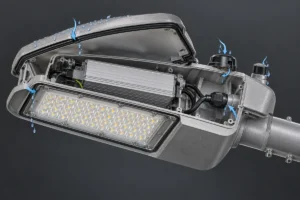
Outdoor luminaires experience rain, wind-driven water, humidity, thermal cycling, insects, dust, salt, and pollution. LED street light troubleshooting after rain should inspect the complete enclosure because a rating cannot protect a luminaire if the gasket is damaged, the cover is not seated, the gland is loose, an entry plug is missing, or the housing is cracked.
What to inspect after safe isolation
- Water tracks around the cover, gland, receptacle, breather, or housing joint.
- Compressed, twisted, hardened, contaminated, or missing gaskets.
- Loose fasteners, cracked lenses, distorted covers, and impact damage.
- Corroded terminals, connectors, driver cases, or LED boards.
- Cable routing that directs water toward an entry point.
- Incorrect mounting orientation or blocked drainage features.
Corrective action
Replace damaged sealing components and any electrical part affected by water or corrosion. Clean and close the luminaire according to the manufacturer’s instructions. Correct the cable entry, installation orientation, fastener torque, or bracket alignment that created the path.
Where repeated ingress affects the same model or zone, review the luminaire construction and the real exposure, including pressure cleaning, flooding, coastal salt, industrial emissions, and temperature cycling. Do not energize wet equipment simply because it has been dried on the surface.
7. LED Street Light Troubleshooting for Heat, Dimming, and Color Shift
LED output and driver behavior depend on temperature. Restricted heat transfer, heavy contamination, high ambient temperature, incorrect driver settings, or unsuitable components can lead to reduced output, intermittent shutdown, color variation, or premature degradation.
Diagnostic sequence
- Compare the affected light with adjacent units of the same model and age.
- Inspect the lens and thermal surfaces for dirt, paint, debris, nests, or blocked airflow.
- Confirm the luminaire is installed in its intended orientation and ambient environment.
- Check the driver output and configured current against the approved data.
- Compare model, batch, CCT, optic, and replacement history.
- Request manufacturer review if matched units show abnormal color shift or output loss under normal conditions.
Corrective action
Clean only with approved materials that will not damage lenses, coatings, seals, or electrical protection. Correct obstructions and settings. Replace a degraded driver, module, or complete luminaire only after confirming which part is responsible and whether field replacement is permitted.
For a new tender, specify the required operating environment, photometric data, thermal limits, optical configuration, driver, controls, ingress protection, impact resistance, and compliance documents for the exact product offered. The U.S. Department of Energy’s Model Specification for LED Roadway Luminaires illustrates why municipal bid documents should define performance rather than rely on generic product labels.
8. LED Street Light Troubleshooting for Photocells and Smart Controls
Modern roadway lighting may use twist-lock photocells, timers, 0-10V or DALI interfaces, individual lamp controllers, gateways, cellular links, or a central management system. LED street light troubleshooting must separate these control layers because a control failure can leave a healthy luminaire dark, permanently dim, operating during the day, or unreachable from the platform.
Separate the control layers
- Local power: Is correct power available at the pole?
- Luminaire operation: Does the luminaire operate correctly under an approved local test condition?
- Driver interface: Does the driver respond correctly to the specified control signal?
- Node operation: Is the controller powered, addressed, configured, and connected correctly?
- Network path: Can the gateway and platform communicate with the node?
- Command logic: Are schedules, groups, sensor rules, overrides, and permissions correct?
- Feedback: Does the reported status reflect actual light output or only the command sent?
Corrective action
Repair the lowest failed layer before working higher in the system. Recommission replacement nodes and confirm pole IDs, groups, schedules, dimming limits, local fallback, time settings, and alarm behavior. The U.S. Department of Energy’s 0-10V LED streetlight control study documented variation in the dimming behavior of market-available drivers, so compatibility and measured output should be checked across the intended control range.
For connected projects, review the architecture in the smart street lighting solution and confirm the exact controller, communications method, platform, and fail-safe behavior for the order.
Operator-safe observations and specialist-only work
Road inspectors and control-room staff can record pole numbers, outage boundaries, timestamps, weather, control status, visible flicker, daytime operation, brightness differences, corrosion, lens damage, and unstable hardware from a safe position. Photographs taken from ground level and platform alarm logs are useful diagnostic evidence.
Qualified personnel should handle circuit isolation, work at height, cabinet access, voltage measurement, insulation testing, grounding tests, photocell substitution, driver or SPD replacement, internal wiring, sealing repair, and control recommissioning.
Stop work and secure the area when there is:
- A pole, bracket, door, arm, luminaire, or cable that may fall or contact traffic.
- Arcing, smoke, abnormal heat, burning odor, or melted insulation.
- Water inside energized equipment.
- Exposed live conductors or damaged underground-cable infrastructure.
- Repeated breaker or protective-device operation.
- Loss of lighting at a hazardous intersection, crossing, tunnel, work zone, or other safety-critical location that requires traffic management.
How LED Street Light Troubleshooting Prevents Repeat Failures
Start with road and system data
Provide road width, lane arrangement, pole height, outreach, spacing, bracket angle, target lighting class, required illuminance and uniformity, supply voltage, control method, environmental exposure, wind conditions, and applicable standards.
Approve the exact configuration
The approved schedule should identify the luminaire model, wattage, optical code, CCT, driver, surge protection, control receptacle or node, mounting method, cable entries, and available compliance documents. Product substitutions require photometric, electrical, mechanical, and control review.
Validate the lighting design
Use the photometric file for the exact proposed product. Check carriageways, intersections, pedestrian areas, medians, curves, and conflict zones. Confirm that pole geometry and tilt in the calculation match the installation drawings.
Control installation and commissioning
Inspect pole wiring, connectors, grounding, seals, fasteners, aiming, photocell orientation, node addresses, dimming schedules, fallback behavior, and cabinet configuration. Record each installed asset against its pole ID.
Plan maintenance evidence and spare parts
Keep drawings, datasheets, wiring diagrams, photometric reports, commissioning records, asset IDs, batch information, failure photographs, and component-replacement history. Agree on approved drivers, SPDs, photocells, controllers, modules, seals, and complete spare luminaires before the warranty period becomes the only source of parts.
Jinborui supports municipal, government, and EPC roadway projects with LED road luminaires, customized poles, DIALux simulation, CAD drawings, tender documentation, OEM/ODM configuration, installation guidance, and after-sales coordination. Available certifications and test documents should be confirmed for the exact product and destination market through the certificates and compliance page.
Request LED Street Light Troubleshooting Support
For faster LED street light troubleshooting, prepare the project location, road layout, pole schedule, affected pole IDs, supply and control information, luminaire labels, installation date, failure history, photographs, and any measurement or platform records. For a replacement project, also include the target road-lighting performance, quantity, delivery destination, and required documents.
Contact Jinborui’s street lighting team to review recurring LED street light problems, compare replacement options, or request a project-specific roadway lighting proposal.

Written by
sonycao1975@gmail.com
Solar energy specialist at Jinborui Electric Co., Ltd. -- delivering reliable photovoltaic solutions for government and engineering projects worldwide.
Leave a Reply