
All in One Solar Street Light Solution: Components, Operation and Applications
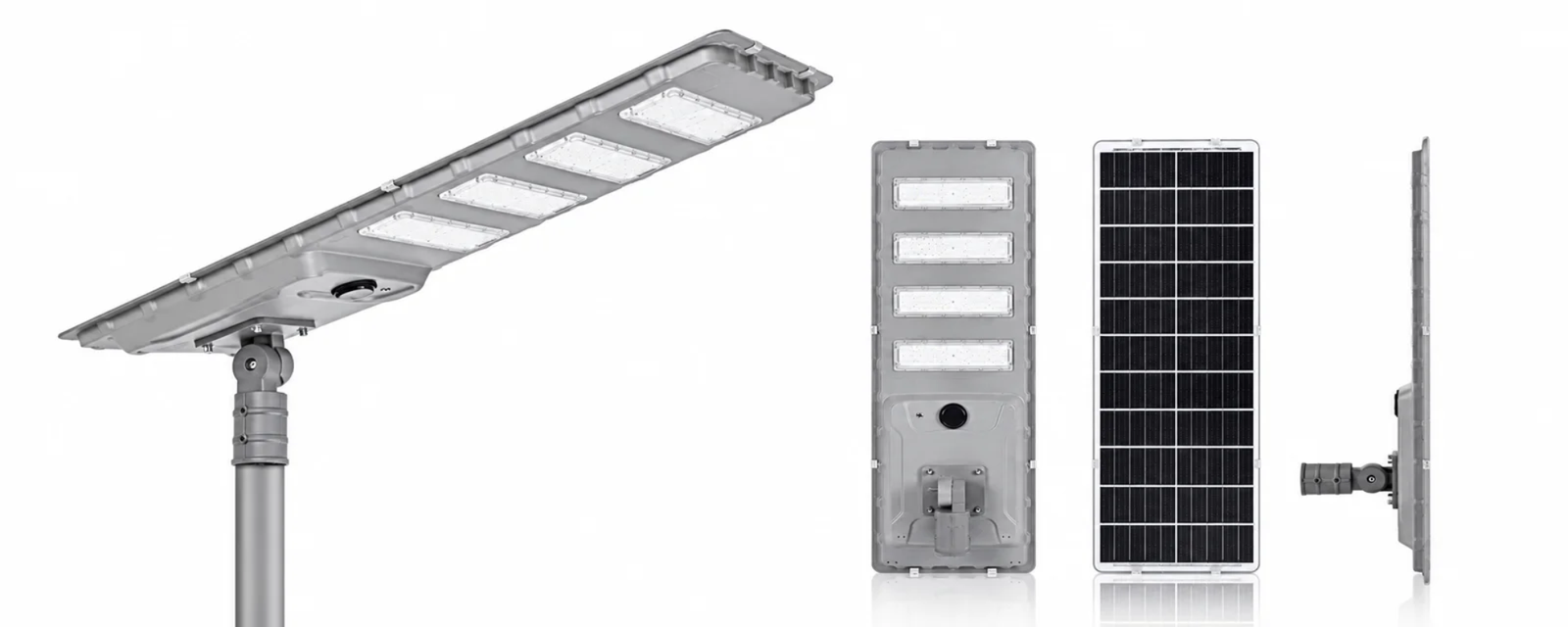
An all in one solar street light solution integrates the photovoltaic panel, rechargeable battery, charge controller, LED lighting module and control sensor into one compact pole-mounted assembly.
Because the main components are combined into a single product, the installer does not need to mount a separate solar panel or battery enclosure. This can reduce the number of field connections and simplify installation.
The compact format is suitable for many roads, pathways, residential developments, parking areas and remote sites. However, the integrated structure also limits the available panel area and links the panel orientation to the luminaire position.
Understanding these characteristics helps buyers decide whether an integrated solar light fits the energy, lighting and maintenance requirements of their project.
<!– IMAGE 1: Insert after the introduction | Visual: Integrated solar street light mounted above a road, with the solar panel visible on top of the luminaire | Alt: “all in one solar street light solution for road lighting” | Source: company product photo / licensed stock / generated visual –>
What Is an All in One Solar Street Light Solution?
An all in one solar street light solution is a self-contained outdoor lighting product that incorporates the main solar-energy and lighting components into one housing or coordinated pole-top assembly.
The integrated components normally include:
- Photovoltaic panel
- LED lighting module
- Rechargeable battery
- Solar charge controller
- Day and night sensor
- Optional motion sensor
- Mounting bracket
- Protective housing
The pole remains a separate structural component, but the principal operating equipment arrives as one assembled luminaire.
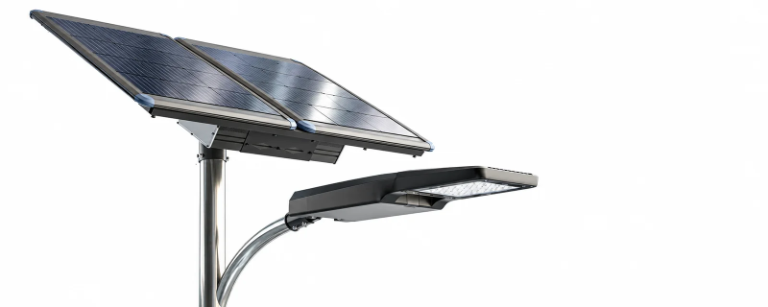
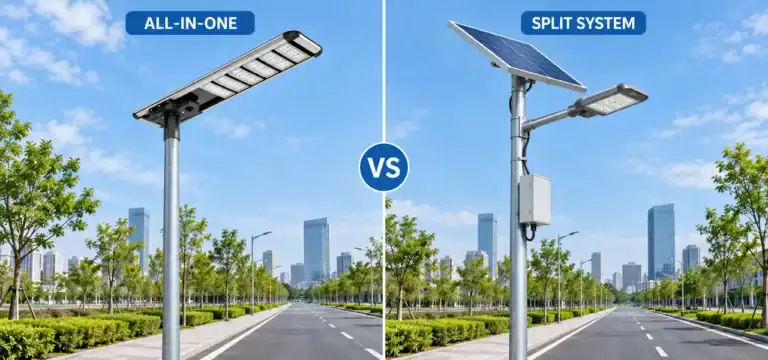
This architecture is also called an integrated solar street light. It differs from an all-in-two system, which uses a separate solar panel, and a split system, which mounts several major components separately.
How an Integrated Solar Street Light Works
Daytime charging
During the day, the photovoltaic panel converts sunlight into electrical energy.
The charge controller regulates the energy flowing into the battery. Charging performance depends on solar irradiation, panel orientation, panel temperature, shading, dirt and system efficiency.
Battery storage
The battery stores the energy needed for nighttime operation.
Its capacity should be configured according to:
- LED power
- Nightly operating hours
- Dimming schedule
- Required autonomy
- Battery discharge limits
- Charging efficiency
- Local temperature
- Seasonal solar conditions
A larger advertised ampere-hour value does not automatically indicate a better system. Battery voltage and usable energy must also be considered.
Nighttime lighting
At dusk, the controller activates the LED module. The luminaire may operate at a fixed output or follow a programmed dimming profile.
Some systems use motion sensors to raise the output when movement is detected and reduce it during inactive periods.
Automatic protection
The controller may protect the battery against overcharging, excessive discharge and other unsuitable operating conditions.
When stored energy is limited, the controller may reduce the lighting output or switch off the load at a predefined threshold.
The exact protection and recovery logic should be confirmed from the controller specification.
Main Components of an All in One Solar Street Light Solution
Integrated photovoltaic panel
The solar panel is incorporated into the upper surface or body of the luminaire.
This reduces separate mounting work, but the available panel area is restricted by the product dimensions. The panel also follows the orientation and tilt of the complete luminaire assembly.
Before selecting the product, check:
- Rated panel power
- Panel dimensions
- Cell technology
- Required installation angle
- Shading exposure
- Cleaning accessibility
- Resistance to wind and impact
The product must be installed where the panel receives adequate sunlight. Placing an integrated luminaire beneath trees or beside a tall building may reduce charging performance.
LED module and optics
The LED module converts the stored electrical energy into light. The lens or reflector distributes the light across the road or target area.
Important factors include:
- Luminous output
- Electrical power
- Optical distribution
- Color temperature
- Glare performance
- Lighting uniformity
- Thermal management
- Replaceability
Buyers should request photometric information rather than selecting the light by wattage alone.
Rechargeable battery
The battery is normally installed inside the luminaire housing.
This compact arrangement reduces exposed equipment, but the battery operates close to other electronic components. Housing temperature and heat dissipation can therefore affect system performance.
Review:
- Battery chemistry
- Nominal voltage
- Rated energy
- Usable energy
- Discharge limit
- Operating-temperature range
- Battery-management protection
- Replacement procedure
A replaceable battery can make future maintenance more practical, particularly for projects involving a large number of lights.
Charge controller
The controller manages battery charging and the nighttime lighting program.
Depending on the product, it may support:
- Dusk-to-dawn switching
- Time-based dimming
- Motion-sensor control
- Battery protection
- Temperature compensation
- System-status indication
- Remote configuration
The controller settings should be coordinated with the battery, panel and LED load.
Motion and daylight sensors
A daylight sensor allows the system to switch automatically between charging and lighting modes.
A motion sensor can change the output when vehicles or pedestrians approach. Detection range, mounting height, road speed and interaction between adjacent luminaires should be considered when using sensor-based operation.
Motion sensing is more appropriate for some applications than others. A busy road may need a stable lighting profile, while a pathway or low-traffic area may benefit from responsive dimming.
Housing and mounting bracket
The housing protects the battery, controller, LED module and internal wiring.
It should provide suitable resistance to:
- Rain
- Dust
- Temperature changes
- Ultraviolet exposure
- Corrosion
- Vibration
- Impact
- Insects
- Unauthorized access
The mounting bracket should allow the luminaire to illuminate the road while keeping the solar panel in a suitable charging position.
<!– IMAGE 2: Insert after “Housing and mounting bracket” | Visual: Cutaway diagram showing the panel, battery, controller, sensor, LED module and optical lens inside an integrated solar light | Alt: “components of an integrated solar LED street light” | Source: original diagram / generated visual –>
Advantages of an All in One Solar Street Light Solution
Simplified installation
The main components arrive as one assembly. Installers normally mount the bracket, attach the luminaire and complete the required setup.
This reduces separate panel brackets, battery enclosures and external field wiring.
Compact appearance
Integrated solar lights have a coordinated design with fewer external components. This can be useful in residential developments, parks, campuses and commercial properties where appearance is important.
Easier logistics
A complete luminaire can simplify ordering, packing, transportation and inventory management. Buyers handle fewer product groups for each lighting point.
Reduced external wiring
Because the primary components are integrated, fewer exposed cables are required. This can reduce connector and cable-routing issues.
Suitable for repeatable projects
An all in one solar street light solution can work well when many similar lighting points share the same road geometry, operating schedule and solar conditions.
The repeatable product format can simplify installation planning and spare-parts management.
Limitations to Consider
Limited solar-panel area
The panel must fit the dimensions of the integrated assembly. This can limit energy-generation capacity compared with a separately mounted panel.
Linked panel and luminaire orientation
The luminaire must direct light toward the target area, while the panel must collect sunlight. These two orientation requirements may conflict at some locations.
Thermal concentration
The battery, controller and LED equipment share a compact enclosure. Thermal design is therefore important, especially in hot climates.
Pole-top maintenance
Technicians may need access equipment to service the battery or controller.
Less component flexibility
The integrated product may offer fewer choices for independently changing panel size, battery capacity or mounting position.
Not suitable for every road
High-output projects, locations with weak solar resources or sites requiring unusual panel orientation may need an all-in-two or split configuration instead.
Suitable Applications
An all in one solar street light solution can be considered for:
- Residential streets
- Rural roads
- Community roads
- Parks and pathways
- Parking areas
- Campuses
- Resorts
- Commercial properties
- Industrial access roads
- Remote facilities
- Emergency access routes
- Areas without convenient grid power
The architecture is most suitable when the available solar exposure, required lighting load and integrated panel size can support the intended operating schedule.
How to Evaluate the System
Check the project location
Solar-lighting performance depends on local conditions. Provide the supplier with the exact project city or coordinates rather than only the country name.
The system should be assessed using conservative seasonal solar conditions, not only annual averages.
Define the lighting requirement
Specify the road width, pole height, pole spacing, mounting arrangement and required lighting performance.
Request a project-specific photometric calculation when the system will be used for a road or other safety-relevant application.
Review the daily energy balance
The panel must generate enough energy to support the nightly lighting load and system losses.
NREL guidance for stand-alone photovoltaic lighting identifies location, nightly runtime, minimum required light level and days of autonomy as important sizing inputs. Review the NREL guidance.
Confirm battery information
Request the battery voltage and energy capacity rather than relying only on ampere-hours. Confirm the operating-temperature range, discharge limit and replacement method.
Examine the control profile
Obtain a clear table showing the light output during each period of the night.
Do not accept unclear descriptions such as “intelligent mode” without knowing how the luminaire behaves.
Review installation orientation
Confirm that the proposed mounting position can direct light toward the road while keeping the panel sufficiently exposed to sunlight.
Check maintenance access
Ask how technicians replace the battery, controller, LED module and sensor. Confirm which tools and lifting equipment are required.
Information to Include in an Inquiry
To obtain an accurate all in one solar street light solution, provide:
- Project location
- Road or area dimensions
- Pole height
- Pole spacing
- Pole arrangement
- Required lighting level
- Operating hours
- Dimming requirements
- Required autonomy
- Shading conditions
- Ambient-temperature range
- Wind conditions
- Quantity
- Installation schedule
- Required reports or certifications
Include photographs, drawings and existing pole information whenever possible.
Questions to Ask the Supplier
Before ordering, ask:
- Which components are integrated into the product?
- What are the panel power and dimensions?
- What is the battery voltage and usable energy?
- Which battery chemistry is used?
- What is the controller’s nightly operating profile?
- Can the dimming program be changed?
- Which optical distribution is supplied?
- Can the supplier provide a photometric calculation?
- How should the product be oriented during installation?
- Are the battery, controller and LED module replaceable?
- What environmental and structural data are available?
- Which installation, commissioning and maintenance documents are provided?
Conclusion
An all in one solar street light solution combines the photovoltaic panel, battery, controller, LED module and sensors in one compact lighting assembly.
Its main strengths are simplified installation, fewer external components and a coordinated appearance. Its main constraints are limited panel area, linked panel and luminaire orientation, and reduced flexibility for independently sizing major components.
A suitable product should be selected from the project’s lighting requirement and energy balance. Road dimensions, pole layout, operating schedule, solar conditions and required autonomy must be considered together.
For a project-specific all in one solar street light solution, provide the installation location, road drawing, pole information and lighting requirements. These inputs allow the supplier to evaluate whether the integrated architecture can support the required lighting performance throughout the year.

Written by
sonycao1975@gmail.com
Solar energy specialist at Jinborui Electric Co., Ltd. -- delivering reliable photovoltaic solutions for government and engineering projects worldwide.
Leave a Reply