
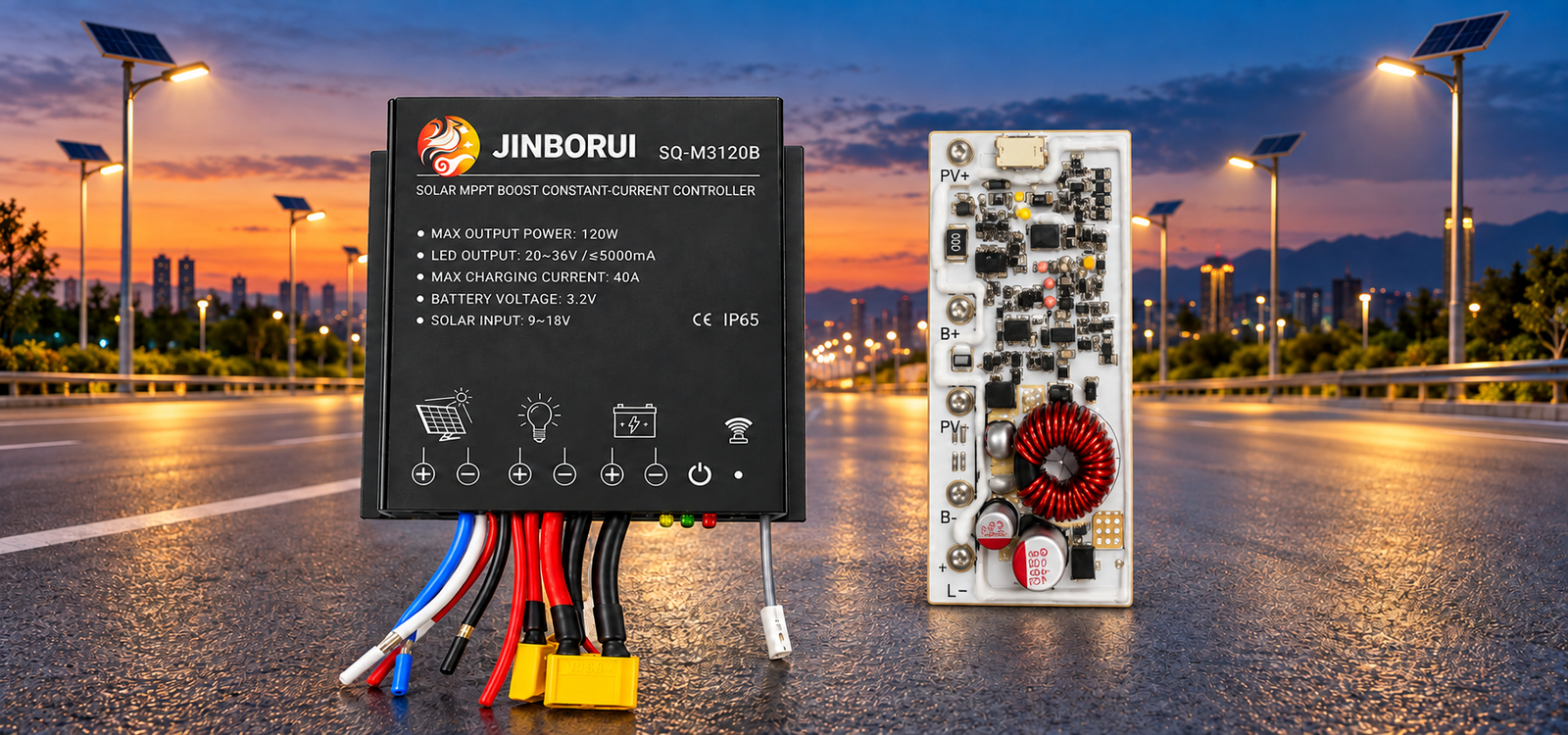
Solar Street Light Controller: Functions, Types and How It Works
A solar street light controller is the electronic unit that coordinates the solar panel, battery and LED luminaire. During the day, it regulates battery charging. After sunset, it switches the light on, follows the programmed dimming schedule and protects the battery from excessive discharge. In many systems, it also records operating data or communicates with a remote management platform.
The controller is therefore not just a switch or charger. It is the system’s energy manager. A mismatched controller can leave available solar energy unused, apply the wrong charging profile, switch the lamp at the wrong time or shut the light down before dawn—even when the panel, battery and luminaire are individually suitable.
What does a solar street light controller do?
Most street-light controllers combine five core functions:
- Solar charging control: They regulate the voltage and current delivered from the photovoltaic module to the battery.
- Battery protection: They limit overcharging and reduce or disconnect the lighting load when the battery reaches a configured low-energy threshold.
- Automatic night detection: They identify sunset and sunrise from PV voltage, a light sensor or an astronomical schedule, depending on the design.
- LED load control: They switch the luminaire and may send a dimming signal to a compatible LED driver.
- Operating logic: They execute timed dimming, motion-sensor response, fault handling and, in connected systems, remote commands.
Texas Instruments demonstrates this combined role in its solar street light reference design, which integrates an MPPT charger and LED driver. Commercial controllers use different architectures, so the relevant product datasheet—not a generic feature list—should govern final system design.
How a controller works through a 24-hour cycle
1. Daytime: harvest and charge
When the PV module produces sufficient power, the controller directs energy to the battery using the configured charging algorithm. The profile must match the battery chemistry, nominal voltage and battery-management arrangement. Lead-acid and lithium batteries require different charging logic, and a lithium pack may depend on its BMS for additional cell-level protection.
2. Sunset: confirm the transition
As PV voltage falls, the controller determines whether night has started. A delay or filtering rule helps prevent a passing cloud, shadow or temporary obstruction from switching the lamp on during the day. Once the night condition is confirmed, the controller activates the LED load according to the selected program.
3. Night: deliver the lighting schedule
The controller may run at full output during evening traffic, dim during low-traffic hours and increase output again before dawn. A motion sensor can temporarily raise brightness when pedestrians or vehicles are detected. This schedule is central to the nightly energy budget: a 60 W luminaire does not necessarily consume 60 W for the entire night if a verified dimming program is used.
Victron Energy’s official streetlight controller settings provide a practical example of sunset, sunrise and solar-midnight anchors working with load-output and dimming rules.
4. Low-energy protection: preserve the battery
If battery voltage or state of charge reaches the configured limit, the controller can dim or disconnect the load. This behavior may look like a lamp fault, but it is often a protective response to low solar input, shading, an undersized energy system, battery aging, excessive load or incorrect settings.
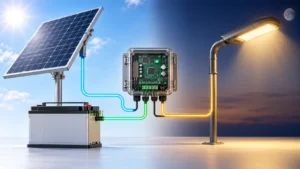
PWM vs MPPT solar street light controllers
PWM and MPPT describe how the controller manages power between the PV module and battery. They are not complete measures of controller quality.
| Factor | PWM controller | MPPT controller |
|---|---|---|
| Basic approach | Rapidly switches the panel connection to regulate charging | Tracks the panel’s maximum power point and converts available PV power for the battery |
| Voltage relationship | Best suited to closely matched panel and battery voltage classes | Allows more flexibility between PV operating voltage and battery voltage |
| Typical strengths | Simpler architecture, lower cost and easy servicing | Better energy harvesting potential and more design flexibility |
| Key limitation | Available panel power can be underused when operating conditions or voltages are poorly matched | Higher cost and greater dependence on algorithm, conversion limits and thermal design |
| Suitable evaluation | Compact, cost-sensitive systems with a generous energy margin | Energy-constrained, higher-power or variable-condition projects |
MPPT is not automatically the correct choice for every small light, and the label alone does not prove better field performance. Compare the PV input window, conversion limits, charge current, thermal derating, standby consumption and actual MPPT behavior as part of the complete solar street lighting solution.
Integrated and split-system controllers
In an all-in-one solar street light, the controller is housed inside the luminaire assembly and matched to the built-in panel, battery and LED module. This reduces field wiring and installation time, but replacement parts must remain compatible with the complete assembly.
In a split solar street light, the panel, battery, luminaire and controller are separate modules. This arrangement gives designers more freedom to size and position components, but it increases the importance of cable loss, enclosure design, connector quality and commissioning records.
Controller functions that matter in real projects
An intelligent solar controller may include many features, but a useful specification should connect each function to a project requirement.
Battery-compatible charging
Confirm supported battery chemistry, nominal voltage, charging stages, temperature behavior and the relationship between the controller and BMS. The solar street light battery options should be reviewed together with the controller rather than as an independent purchase.
Load and dimming control
Check whether the controller powers the LED load directly, drives a separate constant-current driver or supplies only a control signal. Confirm the dimming interface and logic—such as PWM, 0–10 V or a model-specific digital interface—with both the controller and LED-driver documentation.
Electrical protection
Relevant protections can include reverse polarity, reverse current, short circuit, overcurrent, overtemperature, battery overcharge and low-voltage load disconnect. Ask the supplier to state the conditions and recovery behavior for each protection instead of accepting a generic “full protection” statement.
Environmental protection
The controller’s operating temperature, thermal derating, humidity rating, enclosure, cable entries and mounting location all affect reliability. The official IEC 60529 overview defines the IP code used to classify enclosure protection against solid objects and water. An IP rating does not by itself demonstrate resistance to salt mist, UV exposure, condensation, electrical surge or poor cable-gland installation.
Monitoring and communications
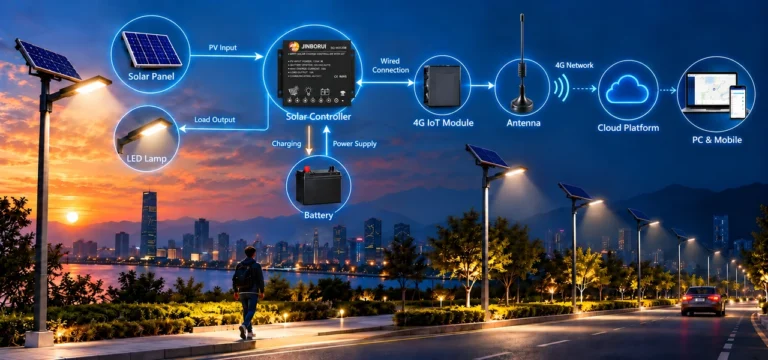
Connected controllers may use Bluetooth for local commissioning or 4G, NB-IoT, LoRa and other networks for remote monitoring. Specify the required data points, alarm logic, update interval, user permissions, platform access, data retention and communication costs. “IoT ready” is too vague for a tender or purchase order.

What buyers should verify before approving a controller
Use a coordinated system schedule rather than comparing controller price alone. At minimum, record:
- Controller manufacturer, model and control method
- Nominal battery voltage and supported battery chemistry
- Maximum PV open-circuit voltage under the coldest expected condition
- Rated charge current and load current, including derating limits
- LED-driver or dimming-interface compatibility
- Low-voltage disconnect and reconnect logic
- Dusk/dawn detection method and delay settings
- Timed dimming and motion-sensor program
- Operating temperature, enclosure location and ingress protection
- Required surge, reverse-polarity and short-circuit protection
- Local and remote commissioning method
- Fault codes, event logs and communications protocol
- Warranty, firmware support and replacement compatibility
Then check these values against the PV module, battery, LED load, cable lengths, local solar resource and required autonomy. Jinborui’s split solar street light range shows how the controller functions as one part of a coordinated system rather than as a standalone component.
Common solar street light controller questions
Is a solar street light controller the same as a solar charge controller?
Not always. A standard solar charge controller primarily manages battery charging and protection. A street-light controller also needs load-control functions such as dusk-to-dawn switching, timed dimming or an interface to the LED driver. Some products combine both roles in one unit; others use separate devices.
Does an MPPT controller always make a solar street light run longer?
No. MPPT can improve energy harvesting when the PV and battery voltages and operating conditions make that conversion useful, but runtime still depends on panel size, solar irradiation, battery capacity, load profile, losses and settings. A poor energy balance cannot be corrected by the controller label alone.
Why does a solar street light turn off before dawn?
The controller may be executing a timer program or protecting a low battery. Other possible causes include insufficient daytime charging, shading, battery degradation, excessive load, cable loss or incorrect thresholds. Diagnose the measured PV, battery and load conditions before replacing the controller, then send the readings and controller model through the technical inquiry page if system-level support is required.
Can one controller work with any battery?
No. The controller must support the battery’s chemistry, nominal voltage, charging limits and protection strategy. Lithium systems also require a compatible relationship between the controller and battery-management system.
Coordinate the controller with the complete lighting system
The correct controller is the one that operates safely inside a coordinated solar-lighting design. Define the site, required lighting level, operating schedule, local climate, PV module, battery, LED load and communications requirements before selecting the model.
For a project-specific configuration, review Jinborui’s solar street lighting solution and send the project location, road dimensions, required operating hours, autonomy target and component requirements through the project inquiry page.

Written by
sonycao1975@gmail.com
Solar energy specialist at Jinborui Electric Co., Ltd. -- delivering reliable photovoltaic solutions for government and engineering projects worldwide.
Leave a Reply