
Solar Street Light Controller Modes: 5 Proven Options
Solar street light controller modes determine when an off-grid luminaire turns on, how its output changes through the night, and when the system must reduce or disconnect the load to protect the battery. The five practical control options are dusk-to-dawn switching, time control with staged dimming, motion sensing, battery protection, and remote control. They are not always separate alternatives: a well-designed street light normally combines several modes in one operating sequence.
For municipal buyers, EPC contractors, and distributors, the right mode is the one that meets required lighting hours without exceeding the energy available from the solar panel and battery. This guide explains the control hierarchy, advantages, limitations, and specification questions that matter in a commercial project.
How Solar Street Light Controller Modes Work Together
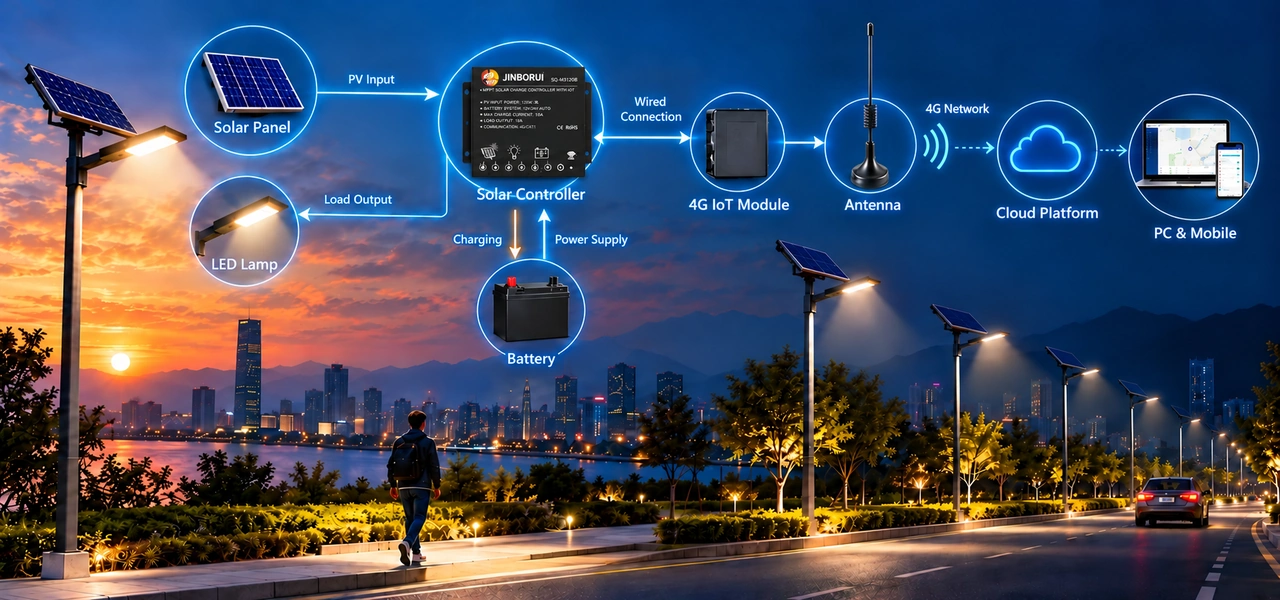
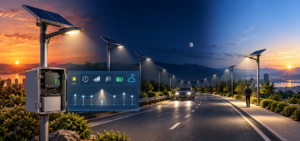
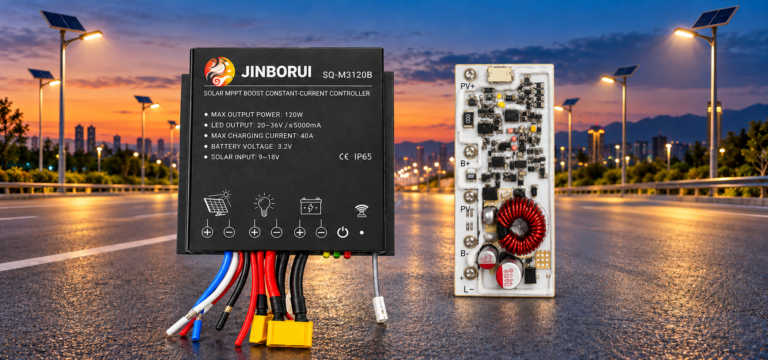
A solar controller sits between the PV module, battery, and LED driver. During daylight it manages battery charging. At night it authorizes the lighting load and, where supported, sends a dimming signal to the LED driver. In a connected system it may also exchange status, alarms, and commands with a gateway or cloud platform.
The important point is priority. A typical logic stack works like this:
- Day/night detection decides whether nighttime operation is permitted.
- Time control selects the scheduled brightness for that part of the night.
- Motion sensing temporarily overrides the scheduled dim level when activity is detected.
- Battery protection limits or disconnects the load if voltage, state of charge, temperature, current, or another protected condition crosses its threshold.
- Remote control changes approved settings and reports operating data, but should not defeat essential protection limits.
This hierarchy prevents conflicting commands. For example, a remote request for 100% output should not force the lamp to remain at full power when the battery has reached its low-voltage disconnect threshold.
1. Dusk-to-Dawn Solar Street Light Controller Modes
Dusk-to-dawn control switches the luminaire on after sunset and off after sunrise. Many standalone controllers infer day and night from PV voltage. Others use a dedicated photocell or astronomical time data. Configurable detection delays help prevent passing clouds, lightning, vehicle headlights, or temporary shading from causing false switching.
The simplest dusk-to-dawn controller keeps the lamp at one output level all night. It is easy to commission and is appropriate where continuous, consistent lighting is mandatory and the solar array and battery have been sized for the worst design period. However, full output throughout the night creates the highest energy demand.
More advanced solar street light controller modes use sunset and sunrise as moving time anchors. Unlike fixed clock times, these anchors follow seasonal changes in night length. Some controllers also calculate “solar midnight,” the midpoint between detected sunset and sunrise. Victron Energy’s official streetlight settings documentation provides one manufacturer example of these solar-time anchors. They are useful for dividing the night into several operating stages, although a controller may require several complete day/night cycles to synchronize.
Solar Street Light Controller Modes for Reliable Day/Night Detection
When reviewing a dusk to dawn controller, ask the supplier to state the detection method, voltage thresholds, delay range, and behavior after a power interruption. A good project specification should also define whether the lamp remains off during daytime commissioning and whether a manual test function is available.
For a broader system view, see our commercial solar street lighting solution, which explains how the controller works with the PV module, LiFePO4 battery, LED luminaire, and project-specific lighting design.
2. Time-Control and Staged-Dimming Solar Street Light Controller Modes
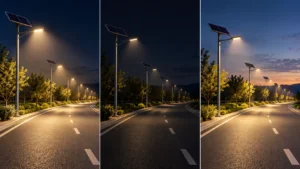
Time control divides the night into operating periods. Staged dimming assigns a different output to each period. A project might require high output after sunset, reduced output during low-traffic hours, and higher output again before sunrise. This solar street light dimming schedule can reduce nightly energy use while preserving useful light when demand is highest.
Common scheduling references include:
- a fixed duration after sunset;
- calculated solar midnight;
- a defined period before sunrise; and
- a real-time clock in controllers that support calendar-based schedules.
The controller and LED driver must use compatible dimming interfaces. Depending on the product, this may be PWM, 0–10 V, DALI, or another defined control signal. A schedule shown in software does not prove that the luminaire can execute it; the controller output, cable, driver input, and firmware configuration must all be compatible.
Example Solar Street Light Controller Settings
The following sequence is illustrative, not a universal prescription:
| Operating period | Example output | Control purpose |
|---|---|---|
| Sunset to 22:00 | 100% | Supports evening pedestrian and vehicle activity |
| 22:00 to 05:00 | 40% | Conserves stored energy during low traffic |
| 05:00 to sunrise | 70% | Raises visibility for early-morning activity |
| Daytime | Off | Allows solar charging and prevents wasted load |
Final solar street light controller settings should be based on target illuminance, road classification, LED power, battery capacity, local irradiation, seasonal night length, desired autonomy, and applicable lighting rules. Buyers should request the complete nightly watt-hour calculation rather than approving percentages alone.
3. Motion-Sensing Solar Street Light Controller Modes
Motion sensor street light control keeps a lower background level during quiet periods and raises brightness when a pedestrian, bicycle, or vehicle enters the detection area. After a hold time, the lamp returns to its scheduled level. This mode can extend autonomy or allow a more efficient system design on low-traffic roads, pathways, parks, campuses, and residential access streets.
PIR sensors detect changes in infrared energy and are common in compact luminaires. Microwave or radar sensors can offer different detection characteristics and may be integrated into more advanced systems. The best choice depends on mounting height, road width, target speed, ambient temperature, enclosure material, and the required detection zone.
Specify at least four values: standby brightness, triggered brightness, hold time, and detection sensitivity or range. Also define the fallback behavior if a sensor fails. For main roads or locations requiring uniform continuous illumination, aggressive motion-based dimming may be unsuitable. The lighting requirement should govern the energy-saving strategy, not the other way around.
Our all-in-one solar street lights integrate the panel, battery, LED module, and controller in a compact format that can support automatic and sensor-based operation for suitable applications.
4. Battery-Protection Solar Street Light Controller Modes
Battery protection is not merely another convenience mode. It is a safety and service-life layer that can override the lighting schedule. A controller may limit or disconnect the LED load at low battery voltage, reconnect it after recovery, restrict charging at temperature limits, and protect against overcurrent, short circuit, reverse polarity, or excessive voltage according to its design. Morningstar’s overview of off-grid PV load control illustrates why load-control settings must be matched to the controller and protected load.
Low-voltage disconnect and reconnect values must match the battery chemistry, nominal system voltage, BMS strategy, cable losses, and expected load. Setting the disconnect point too low can deepen discharge and shorten battery life. Setting it too high can cause unnecessary loss of lighting. Because voltage under load is not always an accurate state-of-charge measurement, advanced systems may combine voltage thresholds with current, temperature, or BMS data.
When comparing solar street light controller modes, ask what happens during several cloudy days. Suitable responses may include progressive dimming, shortened operating hours, a reserve-energy stage, or final load disconnection. The intended sequence should be documented before production and tested with the selected battery pack. Review our solar street light battery solutions for additional battery and BMS considerations.
5. Remote-Control Solar Street Light Controller Modes
Remote control ranges from local infrared or Bluetooth setup to networked smart solar lighting control. A connected system may use RS485, DALI, Zigbee, LoRa/LoRaWAN, NB-IoT, 4G, or another project-approved interface. For example, Phocos documents a sealed controller that combines charging, LED power, and an open DALI D4i connection in its CIS-N-MPPT-DALI product information. The technology name alone is not enough; buyers need to know the network topology, gateway requirements, coverage, data ownership, recurring fees, cybersecurity controls, and offline behavior.
Useful remote functions include reading PV, battery, and load data; changing approved schedules; recording energy trends; identifying offline lamps; and reporting alarms. Fleet-level monitoring can reduce inspection time, but it does not remove the need for autonomous local control. If communications fail, each lamp should continue operating with its last valid schedule and local battery protections.
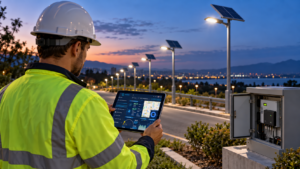
For projects that need central monitoring, explore our smart street lighting capabilities and confirm protocol, dashboard, alarm, API, and commissioning requirements during technical review.
Solar Street Light Controller Modes Comparison
| Mode | Main purpose | Best suited to | Key specification risk |
|---|---|---|---|
| Dusk-to-dawn | Automatic night switching | Roads needing simple autonomous operation | False detection or poorly selected thresholds |
| Time control and staged dimming | Match output to expected demand | Most municipal and commercial projects | Schedule not supported by driver or energy budget |
| Motion sensing | Raise output only when activity occurs | Low-traffic roads, paths, parks, campuses | Missed detection, nuisance triggering, uneven visibility |
| Battery protection | Preserve safe operation and battery life | Every off-grid lighting system | Incorrect thresholds for battery chemistry or BMS |
| Remote control | Configure and monitor many lights | Smart-city and distributed asset projects | Coverage, platform lock-in, security, or offline behavior |
In practice, the most balanced configuration often combines all-night light control, a staged schedule, battery-priority protection, and optional motion or remote functions. The correct combination depends on project risk, not on the number of features advertised.
How to Specify Solar Street Light Controller Modes
Before requesting a quotation, provide the project location, road dimensions, pole height and spacing, required lighting hours, target illuminance, traffic pattern, seasonal climate data, and required autonomy. Then ask each supplier to return the following information in a comparable format:
- Controller model, rated current, nominal voltage, and charging method.
- Day/night detection method, thresholds, and switching delays.
- A complete hour-by-hour lighting and dimming schedule.
- LED driver interface and verified dimming compatibility.
- Sensor type, range, hold time, and fallback behavior, if applicable.
- Battery protection thresholds, recovery logic, and temperature limits.
- Remote protocol, gateway, platform, alarm, data, and offline functions.
- Standby consumption, enclosure rating, operating temperature, and surge protection.
- Parameter records, commissioning procedure, and acceptance-test method.
An EPC team should also request a sample or pilot test before mass deployment. Verify sunset and sunrise transitions, every dimming stage, sensor response, low-battery behavior, recovery after power loss, and communication loss. Parameter records should be retained for future maintenance.
The controller cannot compensate for an undersized energy system. Use the operating schedule to calculate daily load first, then size the PV module and battery for local conditions and required backup days. Our solar street light products can be configured around project-specific road, energy, and autonomy requirements.
Frequently Asked Questions About Solar Street Light Controller Modes
Which controller mode saves the most energy?
Staged dimming combined with motion sensing can reduce consumption substantially on low-traffic sites, but there is no universal saving percentage. Results depend on the standby level, triggered level, traffic frequency, hold time, LED efficacy, and night length. A project-specific energy calculation is more reliable than a generic claim.
Is dusk-to-dawn control the same as time control?
No. Dusk-to-dawn control establishes the night window. Time control changes operation within that window, such as running at 100% for four hours and 40% afterward. Many solar street light controller modes combine both functions.
Can remote control override low-battery protection?
Essential battery limits should retain priority over routine remote commands. The system should reject or safely limit a command that would violate protected operating conditions. Confirm this behavior in the controller documentation and during commissioning.
Do all solar controllers support dimming?
No. The controller must provide a supported dimming output, and the LED driver must accept the same signal. Confirm electrical compatibility, dimming range, fail-safe state, and cable requirements before ordering.
Choose the Right Control Strategy for Your Project
The best solar street light controller modes create a predictable operating hierarchy: dusk detection opens the night window, time control sets the base schedule, motion sensing responds to actual activity, battery protection preserves the energy system, and remote control improves fleet visibility. This combination should be selected from the lighting target and energy budget—not from a generic preset.
Send Jinborui your project location, road dimensions, operating hours, target brightness, traffic pattern, and required autonomy. Our engineering team can help develop a controller schedule, solar-energy configuration, and technical proposal for procurement review. Contact our lighting team to discuss your solar street lighting project.

Written by
sonycao1975@gmail.com
Solar energy specialist at Jinborui Electric Co., Ltd. -- delivering reliable photovoltaic solutions for government and engineering projects worldwide.
Leave a Reply