
H1: High Mast Lighting Design Calculation: How to Choose Pole Height, Spacing, and LED Fixtures
Primary Keyword:
high mast lighting design calculation
Secondary Keywords:
– high mast lighting design
– high mast light height
– high mast light pole height
– high mast lighting spacing
– high mast light pole design
– high mast lighting system
– high mast light pole foundation design
– LED high mast light
Introduction: Why High Mast Lighting Design Requires More Than Wattage Selection
Briefly explain why a high mast lighting project must consider:
– Site size and application
– Required illuminance and uniformity
– Pole height and layout
– LED fixture output and beam distribution
– Glare and light trespass
– Structural, electrical, and maintenance requirements
Explain that the article helps project owners, engineering contractors, lighting designers, and procurement teams prepare a practical high mast lighting specification.
H2: What Is Included in a High Mast Lighting Design Calculation?
H3: Site and Application Information
– Site dimensions and boundaries
– Application type
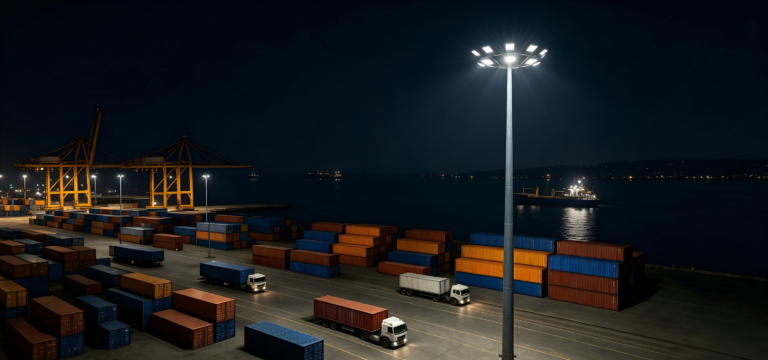
– Roads, parking areas, airports, ports, stadiums, or industrial yards
– Buildings, equipment, and other obstructions
– Vehicle and pedestrian movement areas
H3: Lighting Performance Requirements
– Average illuminance
– Minimum illuminance
– Illuminance uniformity
– Glare limitations
– Light trespass requirements
– Maintenance factor
H3: Engineering and Supply Conditions
– Input voltage and frequency
– Lighting control requirements
– Ambient temperature and humidity
– Wind, rain, dust, and salt exposure
– Maintenance and lowering-system requirements
– Foundation and cable conditions
H2: How to Choose the Right High Mast Light Pole Height
H3: How Pole Height Affects Lighting Coverage
Explain how pole height influences:
– Coverage area
– Fixture aiming angle
– Pole quantity
– Beam overlap
– Glare risk
– Maintenance requirements
H3: Factors That Affect High Mast Pole Height
– Site width and lighting boundaries
– Required illuminance
– Fixture beam distribution
– Pole location
– Obstructions and surrounding buildings
– Wind loading and structural limitations
H3: Why There Is No Universal Best Mast Height
Explain that pole height must be selected together with fixture distribution, pole spacing, lighting targets, and structural requirements.
H2: How to Calculate High Mast Lighting Pole Spacing
H3: Start With the Lighting Area, Not a Fixed Spacing Ratio
Explain why a simple “spacing equals a multiple of pole height” rule cannot replace a project-specific lighting calculation.
H3: Compare Common High Mast Pole Layouts
– Single-side pole layout
– Staggered two-side layout
– Central pole layout
– Perimeter layout
– Layouts for irregular sites
H3: Check Site Edges and Dark Zones
Review:
– Site boundaries
– Entrances and exits
– Turning areas
– Areas behind buildings or equipment
– Low-light zones between poles
H2: How to Select LED High Mast Light Fixtures
H3: Lumen Output Is Only One Selection Factor
Discuss:
– Fixture lumen output
– Luminous efficacy
– Beam distribution
– Beam angle
– Fixture quantity
– Aiming direction
– Performance at the selected mounting height
H3: Select the Distribution Pattern for the Application
Discuss fixture selection for:
– Highways and roads
– Parking lots
– Airports and ports
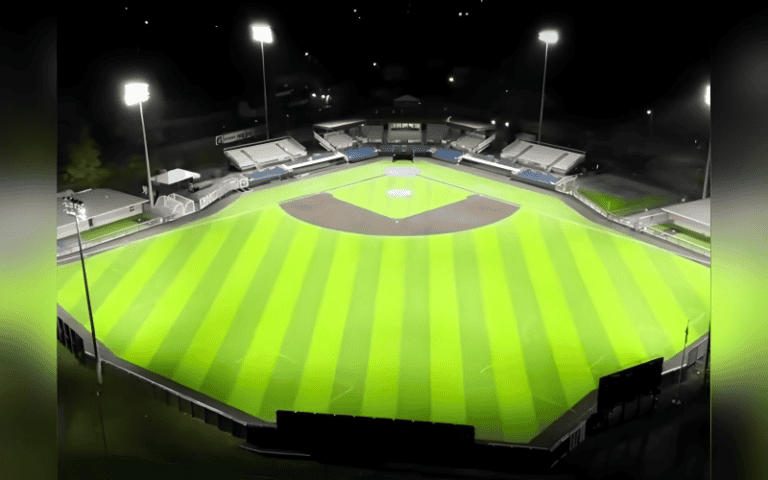
– Sports facilities
– Industrial and logistics yards
H3: Check Environmental and Electrical Compatibility
Cover:
– IP and impact protection
– Operating temperature
– Corrosion and salt-spray exposure
– Input voltage
– Surge protection
– Dimming and control interfaces
– Compatibility with the high mast lowering system
H2: High Mast Lighting Design Calculation Workflow
H3: Step 1: Define the Application and Lighting Criteria
Confirm the site use, lighting targets, operating hours, uniformity requirements, and control needs.
H3: Step 2: Prepare the Site Plan and Design Constraints
Collect:
– Site plan and dimensions
– Roads and building locations
– Existing power sources
– Restricted installation zones
– Neighboring sensitive areas
H3: Step 3: Develop an Initial Pole Layout
Create a preliminary layout based on site geometry, maintenance access, and lighting boundaries.
H3: Step 4: Select Preliminary Pole Height and LED Fixtures
Evaluate pole height, fixture quantity, beam distribution, power, and aiming direction together.
H3: Step 5: Run a Photometric Simulation
Review:
– Average illuminance
– Minimum illuminance
– Uniformity
– Calculation-point distribution
– Edge-area performance
– Glare and light trespass
H3: Step 6: Review Structural, Electrical, and Maintenance Requirements
Check:
– Wind loading
– Foundation requirements
– Cable and distribution capacity
– Grounding and lightning protection
– Lowering-system access
– Maintenance procedures
H3: Step 7: Prepare the Design Package for Approval
Request or provide:
– Lighting calculation report
– Fixture datasheets
– IES or LDT files
– Pole drawings
– Foundation load information
– Wiring and control diagrams
– Commercial quotation and delivery scope
H2: Worked Example: From Site Requirements to a Preliminary High Mast Lighting Layout
Clearly label this as an illustrative example.
H3: Example Project Inputs
Show the type of information required:
– Application
– Site dimensions
– Target illuminance
– Preliminary pole height
– Fixture quantity
– Power supply
– Environmental conditions
H3: Compare Two Preliminary Layout Options
Compare:
– Fewer poles with taller poles
– More poles with shorter poles
Evaluate:
– Coverage
– Uniformity
– Fixture and pole costs
– Foundation quantity
– Maintenance workload
– Glare risk
– Electrical capacity
H3: Why the Final Layout Requires Photometric and Structural Review
Clarify that a preliminary example does not replace project-specific engineering approval.
H2: Design Checks to Request Before Approving a High Mast Lighting System
H3: Photometric Checks
– Whole-area coverage
– Uniformity compliance
– Edge-area illumination
– Dark zones
– Glare and light trespass
H3: Structural and Foundation Checks
– Design wind speed
– Fixture and lowering-system weight
– Foundation loads
– Anchor-bolt requirements
– Soil conditions
– Corrosion protection
H3: Electrical and Maintenance Checks
– Total connected load
– Circuit arrangement
– Surge protection
– Grounding and lightning protection
– Lighting controls
– Fixture replacement method
– Lowering-system maintenance
H2: Common High Mast Lighting Design Mistakes
1. Selecting fixtures by wattage only.
2. Using a fixed spacing ratio instead of a photometric calculation.
3. Checking the center of the site but ignoring edges and entrances.
4. Ignoring the maintenance factor.
5. Confirming pole locations before reviewing foundations and cables.
6. Overlooking glare and light trespass.
7. Comparing fixture price without considering poles, foundations, and maintenance.
8. Failing to define required supplier deliverables before requesting a quotation.
H2: What Information Should You Send to a High Mast Lighting Supplier?
H3: Project Information
– Project country and city
– Site application
– Site plan and dimensions
– Road, building, and obstruction locations
– Proposed installation areas
– Power supply conditions
H3: Lighting Requirements
– Target illuminance
– Uniformity requirements
– Operating schedule
– Control method
– Glare and light trespass limitations
– Zoning or emergency-lighting requirements
H3: Required Supplier Deliverables
– LED high mast light datasheet
– IES or LDT photometric file
– Lighting calculation report
– Pole drawings
– Structural and foundation data
– Control-system proposal
– Quotation, lead time, and warranty terms
H2: Frequently Asked Questions
H3: What Is the Typical Height of a High Mast Light Pole?
Explain that height depends on site dimensions, fixture distribution, lighting targets, pole layout, and structural conditions.
H3: How Far Apart Should High Mast Lighting Poles Be?
Explain that spacing must be confirmed through photometric simulation rather than a universal spacing rule.
H3: How Many LED Fixtures Are Installed on One High Mast?
Explain that the fixture count depends on required illuminance, fixture output, beam distribution, mounting height, and site geometry.
H3: Do High Mast Lighting Projects Require a Calculation Report?
Explain why major road, airport, port, industrial, parking, and sports-lighting projects commonly require documented photometric review.
H3: What Is the Difference Between High Mast Lighting Design and Fixture Selection?
Distinguish system-level design from selecting an individual LED fixture.
H2: Conclusion: Get a High Mast Lighting Design Calculation for Your Project
Invite buyers to submit:
– Site plan
– Project application
– Target illuminance and uniformity
– Pole-location restrictions
– Project location
– Power and control requirements
– Required fixture, pole, and foundation documentation
End with a technical inquiry CTA focused on receiving a project-specific layout proposal and quotation.

Written by
sonycao1975@gmail.com
Solar energy specialist at Jinborui Electric Co., Ltd. -- delivering reliable photovoltaic solutions for government and engineering projects worldwide.
Leave a Reply