
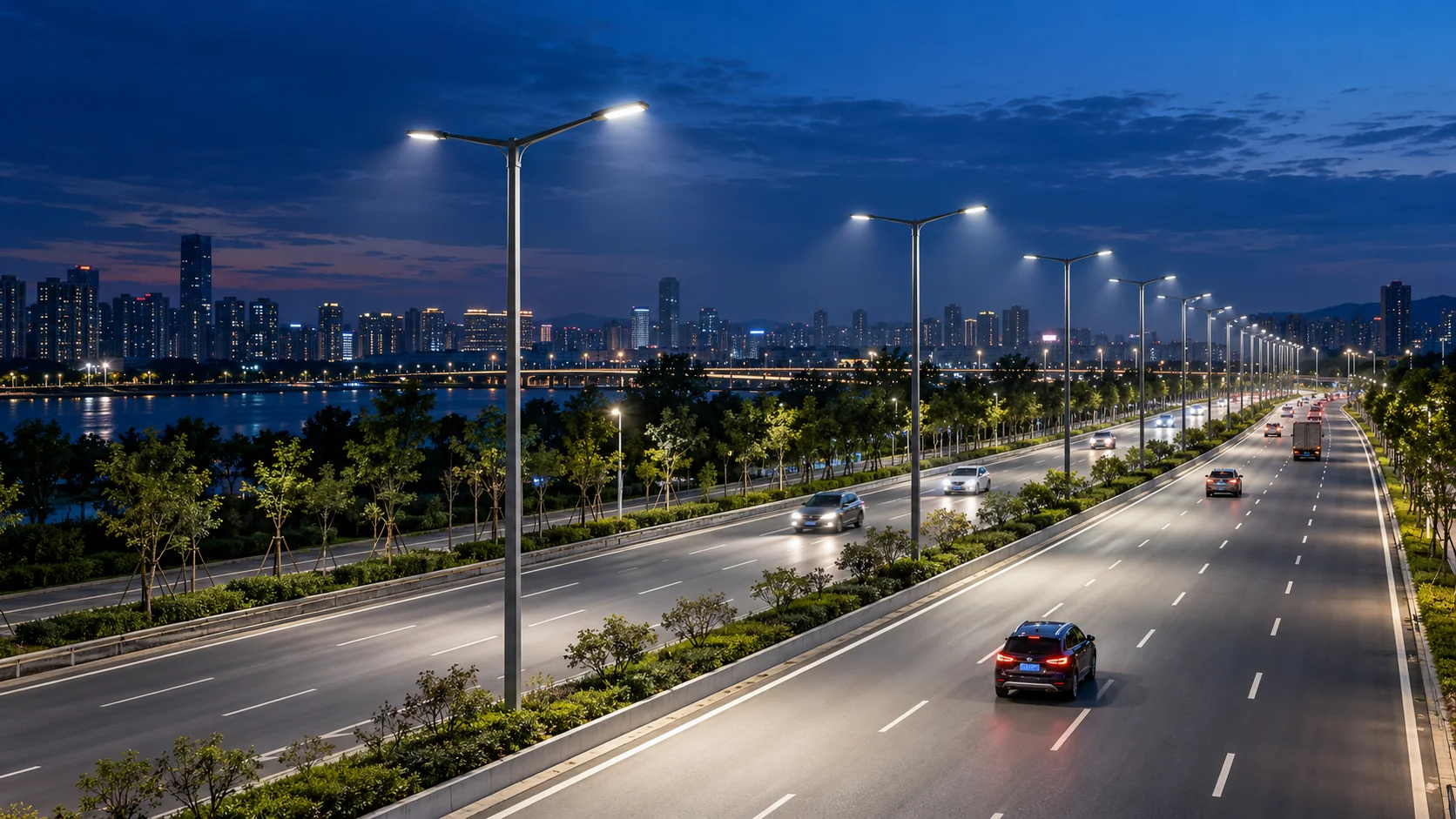
LED Street Light Wattage and Luminous Efficacy: A Road Lighting Selection Guide
The right LED street light wattage is the lowest complete-luminaire input power that can meet the required road illuminance or luminance, uniformity, glare control and maintained performance for the specified pole layout. Wattage alone does not describe how well a road will be illuminated.
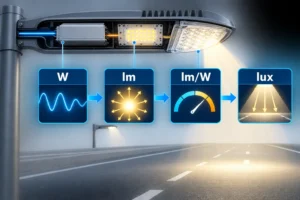
Road lighting buyers should evaluate three connected values: watts show electrical demand, lumens show total initial light output, and luminous efficacy in lumens per watt shows how efficiently the complete luminaire converts electrical power into visible light. The final selection must then be confirmed with the luminaire’s photometric file in a road-lighting calculation.
What LED street light wattage actually tells you
LED street light wattage is the electrical input power consumed by the complete luminaire at a stated operating condition. It is useful for calculating connected load, cable and circuit requirements, solar-system demand and annual energy consumption.
It is not a direct measurement of brightness. Two 100W street lights can produce different lumen outputs because their LED packages, drivers, operating currents, thermal designs and optical systems are different. They can also distribute those lumens differently across the carriageway.
For procurement, confirm that the quoted wattage represents complete-luminaire input power, including the driver. Do not compare the nominal power of an LED module with the measured input power of a finished road luminaire.
Lumens and luminous efficacy in road lighting
Lumens measure the total visible light emitted by the luminaire. Luminous efficacy expresses the relationship between that light output and electrical input power:
LED street light luminous efficacy (lm/W) = initial luminaire lumens ÷ luminaire input watts
For example:
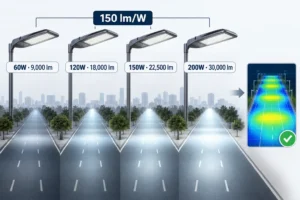
- A 60W street light producing 9,000 lumens has an efficacy of 150 lm/W.
- A 120W street light producing 18,000 lumens also has an efficacy of 150 lm/W.
- A 200W street light producing 30,000 lumens also has an efficacy of 150 lm/W.
All three luminaires have the same energy-conversion ratio, but they are not interchangeable. The required output depends on the road width, lighting class, pole height, spacing, outreach, tilt and optical distribution.
| Metric | What it answers in a road project |
|---|---|
| Input power (W) | How much electricity will each street light consume? |
| Luminaire lumens (lm) | How much initial visible light leaves the complete fixture? |
| Luminous efficacy (lm/W) | How efficiently does the fixture produce those lumens? |
| Illuminance (lux) | How much light reaches the road surface? |
| Luminance (cd/m²) | How bright does the road surface appear to the driver? |
| Uniformity | How evenly is the lighting distributed along and across the road? |
This distinction matters because a high lm/W value does not prove that the light is reaching the correct part of the road.
Why the highest lm/W is not automatically the best road light
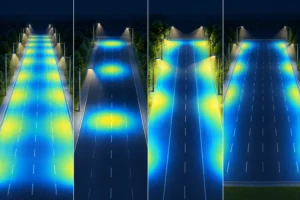
Luminous efficacy is an important screening metric, but roadway lighting is an application result. A luminaire may have high total efficacy while producing excessive light behind the pole, beyond the road boundary or directly into drivers’ eyes. Another luminaire with an appropriate road optic may use its output more effectively.
Road-lighting performance is influenced by:
- the longitudinal and transverse intensity distribution;
- the selected road optic, such as a distribution suited to the road width and pole position;
- mounting height, setback, outreach and tilt;
- pole spacing and single-sided, staggered, opposite or central-median arrangement;
- carriageway width, lane count and surrounding conflict areas;
- pavement reflection characteristics;
- glare and spill-light limits; and
- the required average, minimum and uniformity values.
A wattage conversion chart cannot account for these conditions. Use it only for preliminary budgeting. Final LED street light wattage selection should come from a photometric calculation using the exact IES or LDT file of the proposed model.
Compare system efficacy, not LED chip efficacy
An LED package can have a higher laboratory efficacy than the finished street light. After integration, energy is lost in the driver, optical lens, protective glass and thermal system. Operating current and temperature also affect output.
For a meaningful tender comparison, require complete-luminaire values:
- Rated input power, including the driver.
- Initial luminaire lumens for the quoted configuration.
- Calculated complete-luminaire efficacy.
- Matching CCT, CRI, optic and driver information.
- A model-specific photometric test report and IES or LDT file.
The report and photometric file should correspond to the same part number offered in the quotation. A supplier should not combine the wattage of one model, the chip efficacy of another configuration and the photometric file of a third.
How to select LED street light wattage for a road project
1. Define the road and lighting requirement
Start with the applicable local standard or tender requirement. Record the road type, carriageway and sidewalk dimensions, number of lanes, traffic and conflict areas, pole positions and required lighting class.
The design target may use illuminance, luminance or both. Record the required average and minimum values, uniformity ratios, glare limits and any restrictions for residential windows, nearby properties or the night sky.
2. Fix the pole layout before comparing luminaires
Pole height and spacing strongly influence the required lumen package. Increasing spacing can reduce pole quantity but may make uniformity harder to achieve. A higher mounting position can improve coverage while requiring different output and optical control.
Include the following in the design brief:
- mounting height;
- pole spacing and arrangement;
- arm length and mounting angle;
- distance from pole to carriageway;
- road and sidewalk widths; and
- existing poles or electrical constraints in retrofit projects.
3. Shortlist the lumen and wattage range
Use complete-luminaire efficacy to translate a preliminary lumen requirement into input power:
Estimated input power = required luminaire lumens ÷ luminaire efficacy
If the preliminary design needs about 18,000 lumens, a 150 lm/W street light would have an estimated input power of 120W. This is a starting point, not the final specification. The optical distribution and simulation results determine whether those lumens meet the road requirement.
4. Run a photometric road-lighting calculation
Import the exact IES or LDT file into suitable lighting-design software. Model the road geometry, pole layout, mounting position and maintenance factors. Review the complete calculation rather than only the average lux value.
Check:
- average and minimum road lighting;
- overall and longitudinal uniformity;
- glare or threshold-increment limits when applicable;
- lighting on sidewalks and conflict areas;
- spill light outside the project boundary; and
- results at the required maintenance condition.
Test more than one optic or wattage when the first result meets the average value but fails uniformity or glare requirements.
5. Compare annual road-lighting energy use
For fixed full-power operation:
Annual energy (kWh) = fixture quantity × input power (W) × annual operating hours ÷ 1,000
Suppose both a 150W option and a better-matched 120W option satisfy the same road-lighting requirement. For 500 fixtures operating 12 hours per night, the annual difference is:
30W × 500 × 12 × 365 ÷ 1,000 = 65,700 kWh per year
This comparison is valid only if both designs meet the same maintained lighting, uniformity and glare criteria. Lower wattage is not a saving when it produces a non-compliant or unsafe road-lighting result.
6. Add controls after the base lighting design works
Time-based dimming, traffic-responsive control or a central management system can reduce energy use during low-demand periods. Define the required light levels and power stages for each operating period.
Request the actual driver input at each dimming level. A percentage control signal does not always create an identical percentage reduction in electrical power. Emergency, pedestrian and conflict-area requirements may also limit when and where dimming is appropriate.
Account for maintained road lighting, not only initial lumens
Outdoor luminaires operate through heat, cold, dust, humidity, salt exposure, voltage variation and long nightly duty cycles. The road must continue meeting its lighting requirement after lumen depreciation and dirt accumulation, not only on the installation date.
Review these factors with efficacy:
- lumen-maintenance criterion and test basis;
- ambient-temperature range and thermal design;
- driver life, accessibility and replacement method;
- luminaire dirt and planned cleaning interval;
- IP and IK ratings appropriate to the project;
- surge-protection requirements;
- corrosion protection for coastal or industrial locations;
- power factor and relevant harmonic requirements; and
- warranty coverage for the exact configuration.
Avoid solving maintenance uncertainty by substantially oversizing every luminaire. Excessive initial output increases energy use and may create glare or light trespass. Use a documented maintenance factor and confirm the maintained result in the lighting calculation.
Example using Jinborui LED street light configurations
Jinborui’s current LED street light range includes published configurations from 60W and 9,000 lumens to 300W and 45,000 lumens, based on 150 lm/W system efficacy. Available project parameters also include different CCT, CRI and dimming options.
These configurations allow the engineering team to test several lumen packages without treating wattage as the design target. For example, the same road model can be evaluated with different outputs and optics until the required lighting and energy balance is achieved.
Jinborui’s LED and solar street light manufacturing capability covers LED module and driver-board production, lens assembly, thermal integration and goniophotometer-based light-distribution testing. For project approval, match the selected model with its quotation, bill of materials, photometric report, IES or LDT file and required destination-market documents.
LED road-lighting RFQ checklist
Provide every shortlisted supplier with the same project information and require the same response fields:
- road cross-section, lane count and project length;
- required lighting class and calculation criteria;
- pole height, spacing, arrangement, outreach and tilt;
- exact luminaire model and optical distribution;
- complete-luminaire input power and initial lumens;
- complete-luminaire efficacy in lm/W;
- CCT, CRI and driver configuration;
- IES or LDT file and matching test report;
- maintained-lighting assumptions;
- dimming schedule and input power at each stage;
- electrical, environmental and surge-protection data;
- annual energy calculation;
- warranty and spare-parts plan; and
- certifications and reports required by the destination market.
The most energy-efficient road-lighting proposal is not simply the product with the highest lm/W or the lowest wattage. It is the compliant design that delivers the required maintained road lighting with the lowest practical system power, controlled glare, suitable environmental protection and an achievable maintenance plan.
Send Jinborui your road dimensions, required lighting class, pole layout, operating schedule, environmental conditions, project quantity and documentation requirements through the street lighting project consultation page to request a model-specific luminaire proposal, photometric calculation and energy comparison.

Written by
sonycao1975@gmail.com
Solar energy specialist at Jinborui Electric Co., Ltd. -- delivering reliable photovoltaic solutions for government and engineering projects worldwide.

Leave a Reply