
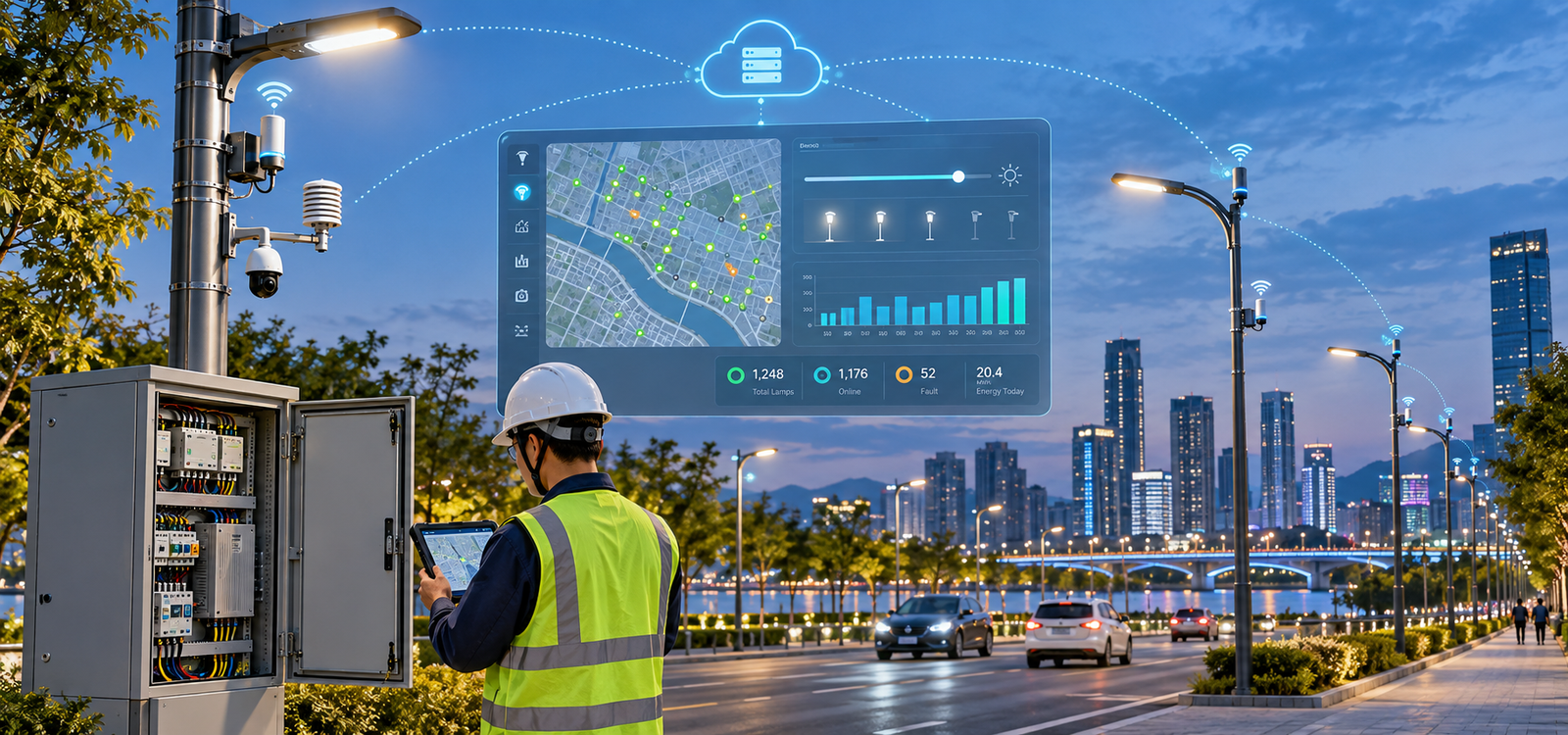
A smart street lighting system project connects outdoor luminaires, control devices, sensors, communication networks, and a management platform so a lighting operator can monitor and adjust the roadway lighting system. Compared with a conventional dusk-to-dawn installation, the project can support scheduled dimming, fault reporting, remote switching, adaptive lighting, energy tracking, or other functions defined in the approved specification.
For a municipal road, industrial park, campus, residential district, or solar-lighting program, the difficult part is not adding a sensor to a lamp. The project has to coordinate the lighting result, pole and foundation, power supply, control logic, network coverage, cybersecurity, maintenance access, and long-term responsibility. A smart street light project is an infrastructure system, not only an LED product.
What is a smart street lighting system project?
A smart street lighting system project is a coordinated deployment of connected lighting points and the controls needed to operate them. A typical lighting point includes:
- An LED luminaire and mounting arm.
- A pole, foundation, access door, grounding point, and cable route.
- A control node or controller that receives commands and reports status.
- Sensors or operating rules for time, ambient light, motion, traffic, or environmental conditions.
- A power supply, protection devices, and, where applicable, a solar module and battery.
- A communication path to a gateway, cabinet, or central management platform.
The project may be grid-connected, solar-powered, or a hybrid of the two. It may also operate with local fallback control if the network is unavailable. The exact functions depend on the luminaire, controller, communications protocol, software, and project specification.
Smart street lighting versus an automatic street light
An automatic street light typically switches on or off using an ambient-light sensor, timer, or simple controller. That is useful for basic operation, but it does not necessarily provide remote monitoring or networked control.
A smart street lighting system can add several layers:
- Local control. A sensor or controller operates one luminaire or one small group.
- Field communication. Control nodes exchange data with a cabinet, gateway, or network server.
- Central management. Operators view status, apply schedules, create dimming groups, and receive alarms.
- Project integration. Lighting data can connect with maintenance workflows, energy reporting, traffic systems, or wider smart-city platforms when the interfaces are defined.
The distinction matters when comparing quotations. A lamp with a photocell is not equivalent to a networked system with device addressing, communication, fault history, and remote configuration.
Core components of a smart street lighting system
LED luminaires
The luminaire still determines the fundamental lighting result. Specify road classification, mounting height, arm projection, optical distribution, power range, dimming method, surge protection, ingress protection, and maintenance access. A smart control layer cannot correct an unsuitable beam pattern or an incorrect pole spacing.
Control nodes and sensors
A control node may be integrated into the luminaire, mounted on the pole, installed in a feeder cabinet, or arranged as a hybrid architecture. The specification should identify the control interface, address method, local memory, manual override, sensor inputs, and behavior during communication loss.
Common inputs include an astronomical schedule, ambient-light level, motion detection, traffic information, cabinet status, and energy measurements. Each input needs a clear rule. For example, a motion sensor should define the detection zone, response time, dimming level, hold time, and return-to-background setting.
Communication network
The network may use wired control, short-range radio, cellular connectivity, mesh communication, or another approved method. Selection depends on road length, pole spacing, cabinet locations, terrain, interference, data costs, maintenance access, and the required availability.
Ask the supplier to document network ownership, SIM or subscription responsibility, gateway quantity, antenna placement, coverage testing, data retention, and local operation when the backhaul connection is interrupted.
Central management platform
The management platform should show the real operating state rather than only the command sent to a device. Useful functions can include a map of lighting points, group control, schedule management, dimming profiles, alarm history, energy records, user permissions, and exportable reports.
Confirm whether the platform is supplied as a license, subscription, local server, or cloud service. Define data ownership, administrator access, software updates, backup, cybersecurity responsibilities, and what happens if the contract or network service ends.
Power and protection
Grid-connected systems need distribution boards, switching, surge protection, isolation, metering, cable sizing, and grounding. Solar systems add a module, charge controller, battery, battery enclosure, and an energy budget for the luminaire, controller, communication device, and sensors.
Do not size a solar street lighting system from the LED wattage alone. Include the control schedule, dimming profile, communication energy, battery autonomy, local solar resource, temperature, and worst-season operating conditions.
Pole, arm, and foundation
The pole supports more than the luminaire. Include the control node, solar module, battery enclosure, camera, antenna, sensor, and brackets in the structural and wind-load review. Confirm pole height, arm projection, effective projected area, design wind speed, flange and anchor-bolt details, foundation interface, maintenance-door location, and cable entry.
For a broader review of material and finish decisions, see the [steel vs. aluminum street light pole comparison](/steel-vs-aluminum-street-light-poles-comparison/).
Control strategies used in smart street lighting projects
Scheduled dimming
The system follows a calendar or astronomical schedule. It can apply different output levels during evening traffic, late-night low demand, and morning activity. This is usually easier to verify than a complex sensor rule, provided the schedule reflects actual road use.
Ambient-light control
Photocells or light sensors can start or stop the lighting system based on measured brightness. Sensor placement, calibration, shadowing, dirt, and local obstructions affect performance. A project should define the fail-safe behavior if the sensor is unavailable or reports an implausible value.
Motion or traffic response
A sensor can raise the light level when people or vehicles approach and return to a lower background level afterward. This may suit paths, low-traffic roads, or security areas, but the detection range and response time must match the road geometry. Avoid applying motion dimming without checking safety, CCTV requirements, pedestrian behavior, and local lighting rules.
Remote fault management
The controller can report events such as lamp failure, power loss, communication loss, abnormal battery condition, door opening, or controller malfunction. Define which events create an alarm, which are stored for review, and which automatically generate a maintenance work order.
Grid-connected, solar, and hybrid project architectures
Grid-connected smart lighting
Grid-connected lighting is usually suitable where a stable distribution network already serves the road. It can support higher continuous power and simpler battery-free operation. The project still needs a clear cabinet layout, protection coordination, metering, grounding, and outage recovery logic.
Solar smart street lighting
Solar lighting is useful where grid extension is difficult or the lighting points are widely dispersed. The design must balance panel area, battery capacity, LED output, dimming schedule, communication energy, and autonomy. Remote monitoring is especially valuable because a low battery or controller fault may otherwise remain unnoticed until the light fails.
Hybrid systems
A hybrid system can combine solar generation with grid backup or another power source. It may improve resilience, but it adds switching, protection, controls, and maintenance requirements. Define the priority source, transfer behavior, battery role, and manual override before procurement.
How to plan a smart street lighting system project
1. Define the service area and lighting result
Map roads, intersections, pedestrian paths, industrial areas, parking zones, and security locations. Record road width, traffic pattern, operating hours, existing poles, tree cover, cabinet locations, and maintenance access.
Then define the required lighting result: mounting height, spacing, optical distribution, dimming levels, control schedule, emergency behavior, and any applicable roadway or municipal standard.
2. Separate required functions from optional functions
Create a minimum functional specification before discussing platforms. Required functions may include dusk-to-dawn operation, scheduled dimming, manual override, fault reporting, and local fallback. Optional functions may include motion response, energy dashboards, environmental sensors, video integration, or open-data interfaces.
This prevents a project from paying for features that do not improve the actual lighting service.
3. Choose the field architecture
Decide whether control is point-to-point, cabinet-based, group-based, or individually addressable. Define gateways, communications coverage, spare capacity, installation access, and the replacement process for a failed node.
4. Coordinate structural and electrical drawings
The approved drawing should show the pole, arm, luminaire, control node, sensors, antenna, cabinet, cable route, foundation interface, grounding, and maintenance access. The electrical design should show circuit protection, isolation, surge protection, conductor sizes, and connection points.
5. Pilot the hardest section first
Use a pilot section that includes the most difficult terrain, longest communication path, highest traffic risk, or weakest power condition. Test the operating schedule, control response, network coverage, alarm behavior, maintenance access, and user acceptance before mass deployment.
Manufacturing and quality points to review
The smart control layer does not remove the need for physical quality control. Review:
- Material certificates and traceability for poles and brackets.
- Pole dimensions, wall thickness, flange-hole position, straightness, and weld quality.
- Galvanizing, powder coating, paint, or other finish records.
- Luminaire photometric data, electrical tests, sealing, and surge protection.
- Controller configuration, device addressing, firmware version, and communication tests.
- Cabinet wiring, labels, terminal blocks, grounding, and protection devices.
- Packing protection for luminaires, control nodes, long poles, antennas, and finished surfaces.
For its documented steel-pole range, Yangzhou Borui uses Q235 steel coil, automatic forming and welding, inner-and-outer hot-dip galvanizing, and outdoor powder coating. The referenced technical information identifies galvanizing and powder-coating thicknesses of at least 80 micrometres, a dedicated grounding bolt, grounding resistance of no more than 10 ohms, a design wind-speed target of at least 36 m/s, and a design service-life target of 20 years or more. These values remain subject to the approved drawing, load calculation, destination requirements, and contract scope.
Commissioning and acceptance checklist
Before final acceptance, test the complete chain from command to physical light output:
- Confirm pole, arm, flange, anchor, grounding, cable-entry, and maintenance-door details.
- Verify luminaire orientation, light distribution, dimming levels, and operating schedule.
- Check every control node’s address, sensor input, firmware, and communication status.
- Test local operation when the network or central platform is unavailable.
- Trigger representative alarms and confirm that they appear correctly in the platform.
- Verify manual override, schedule changes, group commands, and restoration after a power interruption.
- Test solar charging, battery protection, and low-energy behavior where applicable.
- Deliver as-built drawings, device lists, settings, passwords or administrator access, spare parts, and maintenance procedures.
Useful project indicators include lighting availability, communication availability, alarm response time, energy consumption, battery alarms, manual maintenance visits, and the percentage of devices reporting valid data.
Common mistakes to avoid
Treating a photocell as a complete smart system
A photocell can automate switching, but it does not provide the same visibility or control as a connected system. Confirm the actual functions included in the quotation.
Buying the platform before defining the lighting result
Software cannot compensate for poor optical distribution, incorrect pole spacing, inadequate foundations, or insufficient power. Approve the lighting and structural basis first.
Ignoring fallback control
Every remote system needs a defined behavior during network loss, gateway failure, software maintenance, or sensor error. The light should remain safe and predictable while the fault is repaired.
Leaving data ownership unclear
Specify who owns device data, who administers the platform, how credentials are transferred, and how the project will operate if a cloud subscription changes.
Comparing incomplete quotations
Compare the same pole height, arm, luminaire, control functions, communications scope, cabinet, foundation interface, installation responsibility, warranty, and delivery terms. The lowest unit price may exclude the parts that make the project operational.
Where Borui fits a smart street lighting system project
Yangzhou Borui Electric Lighting Co., Ltd. integrates design, manufacturing, and installation for municipal road lighting, urban landscape lighting, and new-energy solar lighting and power-generation projects. Its documented product range includes solar modules, high-power LED luminaires, solar street lights, high-mast lights, urban road and landscape lighting, smart street lights, integrated luminaires, and related traffic structures.
Its project and manufacturing portfolio includes lighting-pole and luminaire installation, steel-pole forming, automatic welding, galvanizing, powder coating, and infrastructure work. For a smart street lighting system project, the buyer should request a coordinated proposal covering the luminaire, pole, control node, communications, platform, power supply, installation, commissioning, training, and after-sales responsibility.
Final RFQ questions
Before placing an order, ask each supplier:
- Which smart functions are included as standard and which are optional?
- Is each lighting point individually addressable, group-controlled, or cabinet-controlled?
- What communication method, gateway quantity, coverage test, and data service are included?
- What happens when the network, sensor, controller, or central platform fails?
- Which lighting, pole, foundation, grounding, and electrical drawings control production?
- What records will be supplied for materials, welds, coatings, electrical tests, and configuration?
- Who owns the platform account, device data, firmware, and administrator credentials?
- What are the pilot, commissioning, training, warranty, spare-parts, and replacement terms?
- Are packaging, freight, installation, testing, and local compliance included in the quotation?
- Can the supplier provide a project-specific bill of materials instead of a catalog-only price?
Send your road layout, pole height, luminaire requirements, control functions, power source, communication preference, quantity, wind conditions, destination, and installation scope to Yangzhou Borui. The team can prepare a coordinated smart street lighting system proposal, pole and luminaire drawings, control architecture, and project quotation for review.

Written by
sonycao1975@gmail.com
Solar energy specialist at Jinborui Electric Co., Ltd. -- delivering reliable photovoltaic solutions for government and engineering projects worldwide.
Leave a Reply