
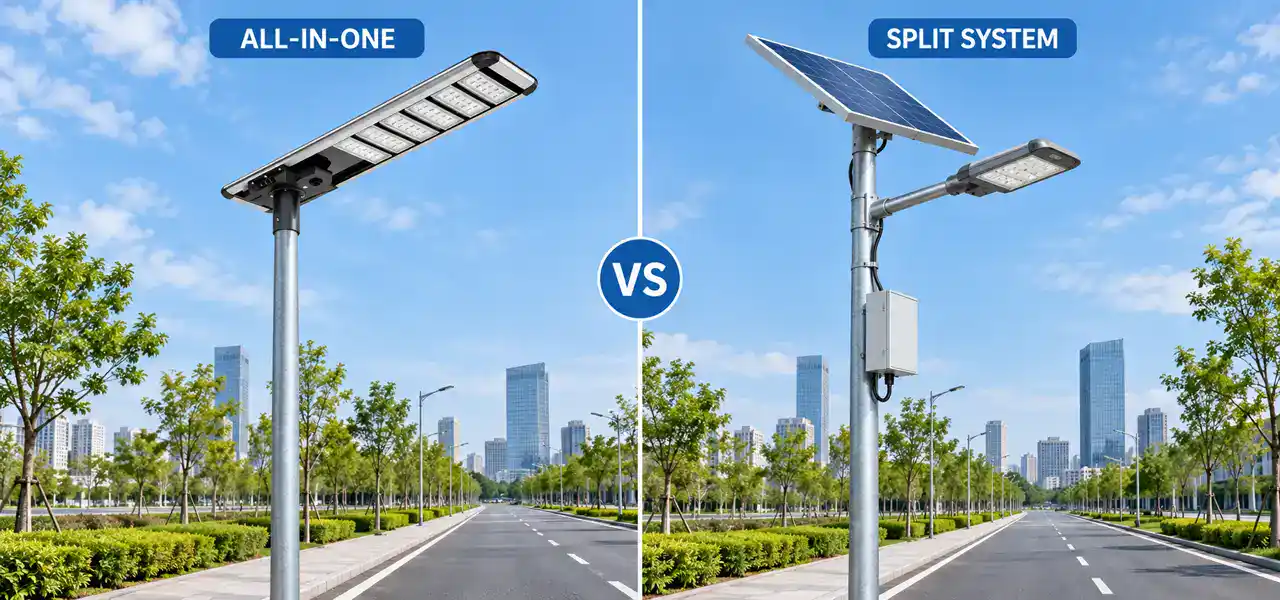
All-in-one and split solar street lights can both provide reliable off-grid lighting, but they solve different project problems. An all-in-one system is usually the better fit when fast installation, compact appearance, simplified logistics, and minimal field wiring are priorities. A split system is usually better when the project needs a larger or independently oriented solar panel, more flexible battery capacity, component-level maintenance, or a highly customized energy design.
The correct choice depends on the lighting requirement, local solar resource, required autonomy, ambient temperature, wind exposure, maintenance plan, and security conditions. Do not select either format from nominal wattage or unit price alone.
What is an all-in-one solar street light?
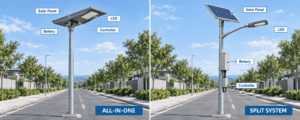
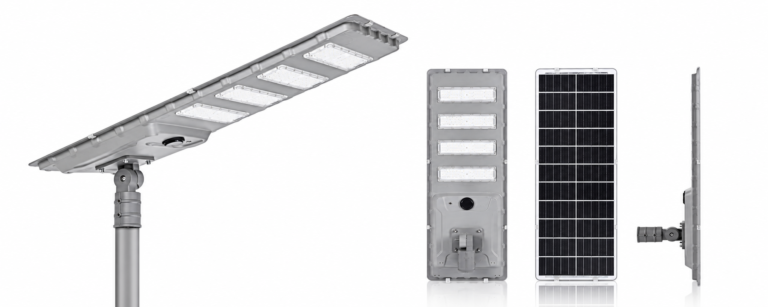
An all-in-one solar street light integrates the solar panel, LED luminaire, battery, and charge controller into one compact assembly. Depending on the product, the integrated head may also include a motion sensor, dusk-to-dawn control, time-based dimming, and remote-control functions.
The unit is mounted to a pole or bracket as one main assembly. This reduces external cabling and the number of separate components that installers must position on site. The format is widely used for residential roads, parks, campuses, parking areas, pathways, and projects where rapid deployment matters.
Integration does not mean every product has the same performance. Panel area, battery capacity, optical distribution, mounting angle, control logic, thermal design, and service access still vary by model.
What is a split solar street light?
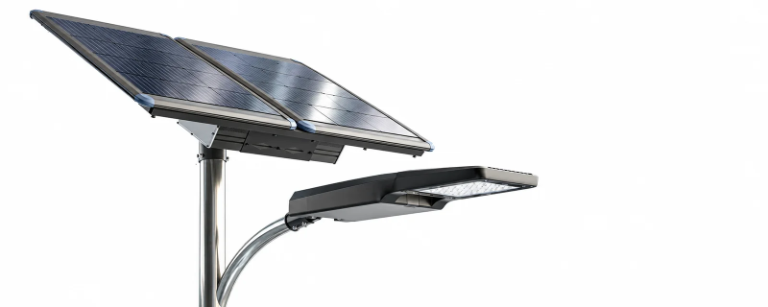
A split solar street light uses separate modules for the solar panel, LED luminaire, battery, and controller. The panel can be mounted and oriented independently from the luminaire, while the battery may be installed in a protected box, inside the pole, beneath the panel, or in another project-approved location.
This modular arrangement gives the designer more freedom to size, position, service, and replace individual components. It is often selected for municipal roads, highways, industrial sites, remote roads, and projects with higher lighting loads or longer required backup time.
Some suppliers also use the term all-in-two for a system that combines some components but keeps the solar panel or battery separate. Because the terminology is not consistent across the market, compare the actual bill of materials and component locations rather than relying on the product name.
Compare both systems on the same project basis
A fair comparison starts with one lighting and energy brief. If the two quotations use different road widths, operating profiles, batteries, solar panels, or pole heights, the buyer is comparing two different solutions rather than two system formats.
Give both suppliers the same inputs:
- Road width, pole height, pole spacing, arm length, and mounting arrangement.
- Target illuminance and uniformity, required optical distribution, and any applicable lighting standard.
- Full-power operating hours, dimming schedule, motion-sensor logic, and seasonal use pattern.
- Site coordinates or reliable solar-resource data, shading conditions, and panel orientation limits.
- Required autonomy during low-sunlight or rainy periods.
- Ambient temperature, wind speed, corrosion exposure, flooding risk, and dust conditions.
- Maintenance capability, spare-parts strategy, theft risk, and expected service response.
- Quantity, packaging, delivery destination, installation scope, and required documentation.
The supplier should then show the energy balance, photometric design, battery and panel sizing basis, structural arrangement, and maintenance method for the proposed system.
All-in-one vs split solar street light comparison
| Decision factor | All-in-one solar street light | Split solar street light | What the buyer should verify |
|---|---|---|---|
| System layout | Panel, battery, LED, and controller are integrated into one main unit | Panel, luminaire, battery, and controller are installed as separate modules | Actual component locations and replaceable parts |
| Installation | Fewer separate parts and external connections can shorten site work | More brackets, wiring, and coordination are normally required | Labor, tools, lifting, wiring, commissioning, and installer skill |
| Solar-panel positioning | Panel position is more closely tied to the integrated fixture and bracket design | Panel angle and direction can usually be adjusted independently | Shading study, tilt range, azimuth, and seasonal solar input |
| Energy configuration | Compact housing can limit available panel area or battery space in some models | Larger or project-specific panel and battery combinations are easier to configure | Energy calculation, usable battery energy, autonomy, and control profile |
| Maintenance | One integrated head simplifies the spare-unit strategy, but internal serviceability varies | Individual modules can usually be inspected and replaced separately | Access method, connectors, diagnostic procedure, and spare parts |
| Appearance | Clean, compact profile with limited visible wiring | More visible brackets, boxes, cables, and connections | Approved drawing and visual requirements |
| Wind and structural load | Compact layout may reduce the number of separate attachments, but the integrated assembly still creates wind area and eccentric load | Separate panel and brackets allow flexible placement but add structural interfaces | Complete wind-load calculation for panel, luminaire, brackets, battery box, and pole |
| Security | Fewer exposed modules and cables can reduce tampering points | Separate battery boxes, cables, and panels need deliberate anti-theft design | Fasteners, cable protection, box location, access control, and asset tracking |
| Customization | Best when a qualified standard platform already matches the project | Better suited to highly customized energy, optical, and component requirements | Approved BOM, drawings, firmware, and change-control process |
| Delivered cost | Can reduce installation labor and packing complexity | Can increase component and installation scope but simplify later module replacement | Like-for-like equipment, freight, labor, spares, maintenance, and replacement cost |
This table is a screening tool. The final selection should be based on the approved lighting design, energy calculation, structural design, and maintenance plan.
1. Energy generation and panel orientation
Solar energy collection is one of the most important differences between the two formats. In an integrated unit, the panel position is influenced by the luminaire body, mounting arm, and product design. A good mounting system may still provide useful adjustment, but the available panel area and orientation range must be checked on the actual model.
With a split system, the panel can normally be aimed independently from the road-facing luminaire. This is useful when the best solar orientation conflicts with the required light distribution, or when a larger panel is needed to recover energy during short winter days.
Do not assume that a separate panel automatically generates more energy. Its output still depends on rated power, cell quality, temperature, shading, soiling, tilt, wiring losses, and controller performance. Request a monthly energy calculation based on the installation location rather than an unexplained daily-sun-hours assumption.
The calculation should show:
- Expected LED energy consumption under the programmed dimming profile.
- Controller and system losses.
- Available solar charging energy in the design month.
- Battery usable energy after the stated depth-of-discharge limit.
- Required autonomy and the recovery strategy after low-sunlight days.
2. Lighting performance and control strategy
The system format does not determine road-lighting quality. Optics, mounting height, pole spacing, roadway geometry, LED output, and dimming logic do.
An all-in-one light may be a strong choice for a pathway or local road when its optical distribution and control program match the site. A split system may be more suitable for a wider municipal road that requires a larger luminaire, more energy storage, or a project-specific operating schedule. In both cases, ask for a photometric calculation using the exact luminaire file proposed for the order.
Review more than the maximum brightness setting. A system that operates at full output for a short period and then dims aggressively is not equivalent to one that maintains a higher level throughout the night. The quotation should state:
- LED power under each operating stage.
- Duration of each time segment.
- Motion-sensor detection logic and standby level, if used.
- Low-battery protection behavior.
- Dawn and dusk switching logic.
- Remote monitoring or group-control functions, if required.
Jinborui offers project configurations with LiFePO4 batteries, dusk-to-dawn control, motion sensing, segmented dimming, and optional smart-control functions. These features should be confirmed in the approved bill of materials and control schedule for the specific order.
3. Installation time and site complexity
All-in-one systems normally reduce field assembly. Installers position the pole and bracket, mount the integrated unit, set the required angle, secure the fasteners, and commission the controller. Fewer external connections can help projects with limited skilled labor, dispersed sites, or short installation windows.
Split systems require more coordination. The crew may need to install the luminaire arm, panel bracket, solar panel, battery enclosure, controller, and interconnecting cables separately. Correct polarity, cable sizing, waterproof connectors, strain relief, grounding, and mechanical protection all need inspection.
The extra work is justified when the modular layout solves a real project constraint. It becomes unnecessary risk when the project does not have trained installers, clear drawings, or a commissioning checklist.
Before ordering, compare:
- Number and weight of site-installed components.
- Preassembly completed at the factory.
- Cable lengths, connector types, and labeling.
- Required lifting equipment and crew size.
- Mounting torque and fastener requirements.
- Controller setup and commissioning procedure.
- Installation manual, wiring diagram, and training scope.
-
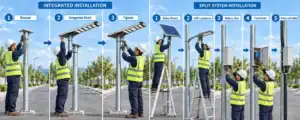
Split solar street light panel luminaire and battery box installation
4. Battery capacity, temperature, and autonomy
An integrated design places the battery close to the solar panel, LED module, and controller. A well-engineered housing must manage heat, sealing, drainage, and service access within a compact space. Buyers should check the stated battery chemistry, rated capacity, usable energy, BMS functions, operating-temperature limits, and enclosure design.
A split layout provides more options for battery size and location. The battery can be positioned away from the LED heat source or installed in a shaded, ventilated, or otherwise protected location when the project design permits. However, every location creates its own risks. A low-mounted box may be easier to service but more exposed to flooding, impact, tampering, or theft. A buried enclosure requires careful drainage, sealing, and access planning.
For both types, request battery information in watt-hours, not only amp-hours. Amp-hour figures cannot be compared without the system voltage. Also confirm the usable depth of discharge, temperature derating, low-voltage cutoff, cell matching, BMS protection, warranty conditions, and replacement procedure.
Jinborui’s solar street light battery options can be configured for integrated and modular systems. The battery selection should be tied to the approved night profile and location-specific energy calculation.
5. Maintenance and spare-parts planning
All-in-one systems reduce the number of external service points. For distributed installations, keeping complete replacement heads can make field service fast: the technician swaps the unit and diagnoses the removed assembly in a workshop. This approach works only when the mounting interface, connector, firmware, and spare model remain compatible.
The tradeoff is that internal component access varies. Some integrated units allow separate battery, controller, or LED-module replacement; others are designed mainly for complete-head replacement. Ask the supplier to demonstrate the service procedure before approving the product.
Split systems are naturally suited to component-level replacement. A technician may replace the controller, battery, panel, or luminaire without changing the complete system. This can reduce the cost of a single failed module, but troubleshooting more connections and separate enclosures may require stronger diagnostic capability.
A practical maintenance comparison should cover:
- Which components can be replaced on the pole and which require workshop service.
- Safe isolation and access steps.
- Diagnostic indicators, controller logs, and fault codes.
- Expected spare parts for the first maintenance period.
- Part numbers and interchangeability rules.
- Warranty replacement process and response time.
- Availability of batteries, controllers, LED modules, seals, brackets, and connectors.
The solar street light controller is especially important because its charging, dimming, and protection logic affects the complete system. Confirm that replacement controllers use the approved battery profile and operating program.
6. Wind load, pole design, and security
An all-in-one product looks compact, but it still adds projected area and weight near the top of the pole. A split system adds a separate solar panel, panel bracket, luminaire arm, battery enclosure, and cable route. Neither arrangement should be mounted on a pole selected only by height.
The structural calculation should include the actual panel dimensions, luminaire shape, brackets, arm projection, component weights, design wind speed, terrain exposure, pole section, flange, anchor bolts, and foundation interface. It should also account for the permitted panel angle because changing the angle changes the wind action.
Jinborui’s manufacturing capability covers solar-light assembly, battery-pack integration, controller configuration, luminaire production, and steel-pole fabrication. Coordinating these elements under one approved drawing helps prevent a panel bracket, arm, or battery box from being treated as an afterthought.
Security also affects the choice. All-in-one units have fewer low-level boxes and exposed cable runs, but their complete head still needs tamper-resistant fastening. Split systems should use protected cable paths, secure battery enclosures, controlled access hardware, and a location-specific anti-theft plan. In high-risk areas, ease of maintenance and ease of unauthorized access must be balanced carefully.
7. Initial price versus total ownership cost
All-in-one systems often simplify purchasing, packing, shipping, and installation because fewer separate items reach the site. A standard integrated platform can therefore be economical for repeat installations that fit its energy and lighting envelope.
Split systems may involve more brackets, cables, boxes, labor, and commissioning. Their modularity can still reduce lifecycle cost when individual components need replacement or when the larger energy configuration prevents chronic undercharging and premature battery problems.
Compare the complete delivered and operating scope:
- Solar light, pole, arm, brackets, battery box, cables, connectors, and fasteners.
- Lighting design, energy calculation, structural drawing, and documentation.
- Packing volume, inland transport, ocean or air freight, and site storage.
- Installation labor, lifting equipment, testing, and commissioning.
- Spare units and component-level spares.
- Routine inspection, cleaning, battery replacement, and fault response.
- Warranty exclusions, return logistics, and local service capability.
A lower unit price is not a saving if the panel is undersized, the operating profile does not meet the lighting requirement, or the maintenance method is impractical.
Which system is better for common applications?
Choose an all-in-one solar street light when:
- The project values quick installation and limited field wiring.
- The required lighting output and autonomy fit a proven integrated platform.
- A clean appearance is important for parks, campuses, parking areas, pathways, or local roads.
- Installers have limited time or electrical assembly capability.
- The site has suitable solar access within the product’s mounting-angle range.
- The maintenance team prefers complete spare-head replacement.
Choose a split solar street light when:
- The solar panel must face a different direction from the luminaire.
- The project needs a larger panel, battery, or luminaire than an integrated housing can accommodate.
- Long nightly operation, higher lighting output, or extended autonomy drives the design.
- Component-level service and future upgrades are important.
- Battery location must be managed separately because of heat, access, or enclosure requirements.
- The project has qualified installers and a controlled commissioning process.
Reconsider either proposal when:
- The supplier has not provided a location-specific energy calculation.
- Nominal wattage is used as a substitute for photometric performance.
- Battery capacity is stated without voltage, usable energy, or operating profile.
- The panel angle, shading, or design-month solar input is missing.
- The pole and foundation have not been checked for the complete assembly.
- The quotation does not identify the battery, controller, LED module, panel, and connectors.
- Maintenance access, spare parts, warranty boundaries, or firmware settings are unclear.
What should buyers ask before ordering?
- Is the proposed system all-in-one, all-in-two, or fully split, and where is each component installed?
- What lighting level and uniformity will the exact luminaire deliver at the proposed height and spacing?
- Which location, month, solar data, shading assumption, and system losses were used in the energy calculation?
- What is the panel rating, adjustment range, and proposed installed direction?
- What are the battery voltage, watt-hour capacity, usable depth of discharge, chemistry, and temperature limits?
- How many nights of autonomy are calculated under the approved dimming profile?
- What happens when the battery reaches the low-voltage threshold?
- Which components are field-replaceable, and which spare parts will be supplied?
- How are cables, connectors, battery boxes, and fasteners protected against water, corrosion, impact, and theft?
- Does the structural drawing include the complete panel, luminaire, bracket, arm, battery, pole, flange, and anchor-bolt arrangement?
- Which inspection records, photometric files, controller settings, wiring diagrams, and test reports will accompany the order?
- Can the supplier provide a sample or pilot installation before full production?
Final recommendation
Choose an all-in-one solar street light when a proven integrated configuration meets the photometric and energy requirements and the project benefits from fast, clean installation. Choose a split solar street light when independent panel positioning, larger energy capacity, modular maintenance, or project-specific customization provides measurable value.
Neither format is universally better. The best system is the one that meets the same lighting target, survives the site environment, supports a realistic maintenance plan, and is documented with a clear bill of materials, energy balance, photometric design, and structural drawing.
Send Jinborui your project location, road dimensions, required lighting hours, autonomy target, pole height, wind conditions, quantity, and delivery destination through the project contact page to receive an application-specific all-in-one or split solar street light proposal.

Written by
sonycao1975@gmail.com
Solar energy specialist at Jinborui Electric Co., Ltd. -- delivering reliable photovoltaic solutions for government and engineering projects worldwide.
Leave a Reply