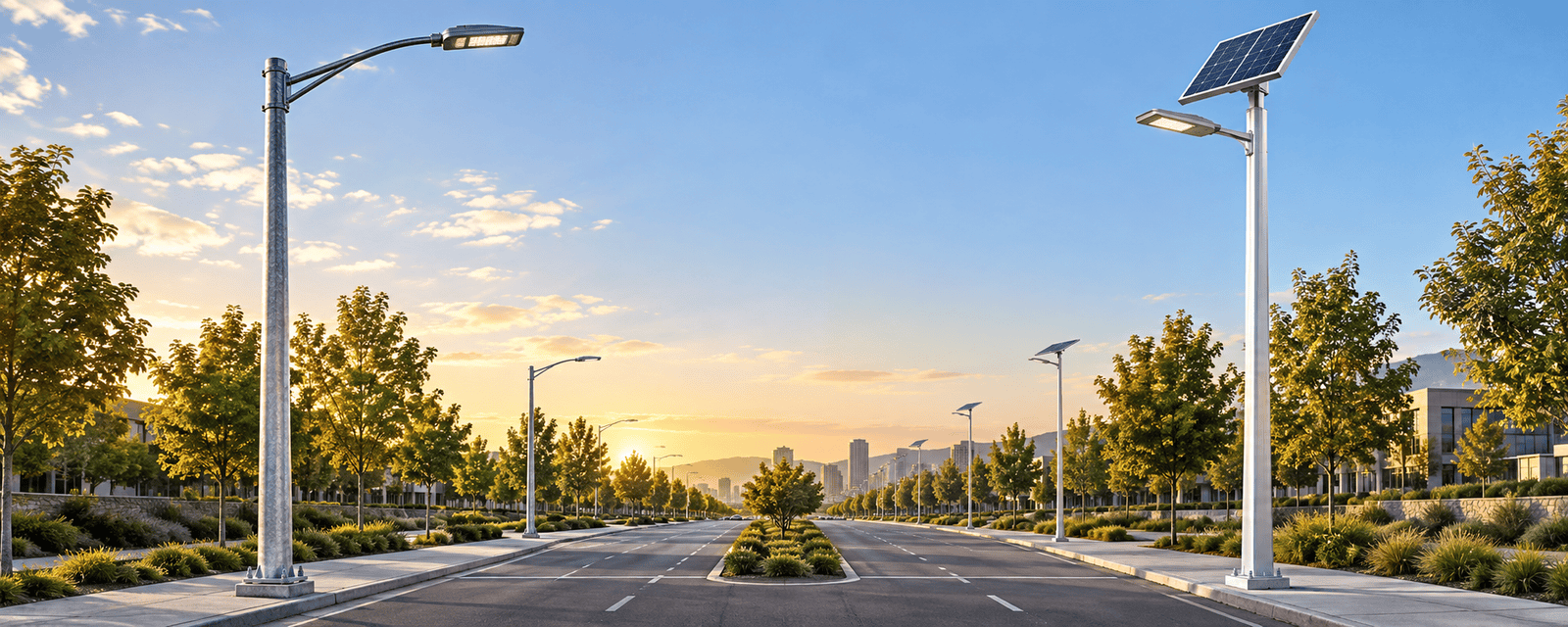
Steel and aluminum street light poles are both used in roadway, municipal, commercial, and solar lighting projects. The better choice depends on the structural load, wind exposure, corrosion environment, installation method, appearance, and delivery requirements.
Short answer: choose steel when structural stiffness, higher luminaire or solar-panel load, long pole lengths, and a controlled galvanized finish are the priority. Choose aluminum when low weight, easier handling, natural corrosion resistance, or a decorative installation is more important. Neither material should be selected from unit price alone; the approved drawing and load calculation must control the final decision.
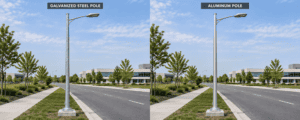
Steel and aluminum poles are not interchangeable by default
A street light pole is part of a complete system that includes the luminaire, arm, cable routing, foundation, anchor bolts, grounding, and maintenance access. Changing the pole material can change the section design, wall thickness, connection details, weight, transport method, and structural calculation.
For a fair comparison, request the same information from both suppliers:
– Pole height, taper, arm projection, and mounting arrangement.
– Luminaire weight, projected area, and any solar-panel or battery enclosure load.
– Design wind speed, terrain exposure, seismic requirements, and local code.
– Foundation and flange dimensions, anchor-bolt pattern, and maintenance-door position.
– Material grade, wall thickness, finish, estimated weight, and inspection scope.
– Quantity, packaging, delivery destination, installation method, and warranty terms.
If a quotation changes several of these variables at the same time, it is not a direct steel-versus-aluminum comparison.
At-a-glance comparison
| Decision factor | Steel street light poles | Aluminum street light poles | What the buyer should confirm |
|—|—|—|—|
| Structural stiffness | Typically favored for demanding roadway, high-mast, and larger-load designs | Can meet project loads when correctly designed, but section and alloy details matter | Load calculation, effective projected area, deflection limits, and connection design |
| Weight and handling | Heavier; may require more lifting and handling capacity | Lighter; can simplify transport and installation in suitable designs | Pole weight, bundle dimensions, lifting plan, and foundation handling |
| Corrosion strategy | Usually depends on galvanizing, coating, paint, or a duplex system | Has natural corrosion resistance, but alloy, joints, surface condition, and environment still matter | Exposure class, finish specification, coating or surface treatment, and inspection method |
| Appearance | Galvanized or powder-coated finishes support many project colors | Often selected for a clean metallic or decorative appearance | Color, texture, coating durability, and sample approval |
| Solar-lighting use | Useful when panel area, battery enclosure, or arm loads increase structural demand | Useful where low weight supports installation or transport priorities | Complete solar assembly load, wind area, battery access, and mounting details |
| Maintenance | Coating damage and cut or drilled areas require controlled repair | Surface damage and dissimilar-metal contacts require attention | Repair method, fasteners, isolation, grounding, and spare parts |
| Delivered cost | Often competitive for higher-load or standardized projects | May reduce handling weight but can carry different material and fabrication costs | Like-for-like scope, freight, installation, repair, and lifecycle assumptions |
The table is a screening tool. It does not replace a project-specific structural design or material specification.
1. Structural strength and wind-load capacity
Strength is usually the first reason buyers compare steel and aluminum. In general, steel provides higher stiffness for a given overall pole form, while aluminum can achieve the required performance through alloy selection, geometry, wall thickness, taper, and connection design.
The important question is not simply “Which material is stronger?” Ask whether the proposed pole can safely support the complete effective projected area of the luminaire, arm, solar panel, and accessories under the project wind conditions.
Request the following from each supplier:
1. The design wind speed and code basis.
2. Luminaire and accessory loads used in the calculation.
3. Deflection and stress checks for the pole, arm, flange, and anchor connection.
4. The selected material grade, wall thickness, and section geometry.
5. The approved drawing revision that will control production.
Steel is often the more straightforward choice for high-mast poles, long arms, larger luminaires, highway applications, or solar assemblies with substantial wind area. Aluminum can be a good fit when the design is engineered for the load and the lighter structure improves installation or transport.
Do not accept a material substitution based only on a lower weight or a catalog height. A lighter pole is not automatically a lower-risk pole.
2. Weight, transport, and installation
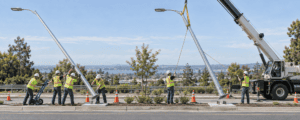
Aluminum’s lower density can make sections easier to move, lift, and position. This can matter where access is restricted, lifting equipment is limited, or installation labor is expensive. Lower weight may also simplify export packing and site handling, but the complete shipment still includes arms, brackets, hardware, and luminaires.
Steel poles are heavier, but that weight can be acceptable or advantageous when the project already has lifting equipment and needs higher stiffness or robust structural sections. The foundation and anchor system must be designed for the actual pole and overturning loads; pole weight alone does not determine foundation size.
Compare these line items rather than relying on a general “easy to install” statement:
– Net pole weight and shipping weight.
– Maximum section length and bundle dimensions.
– Crane, forklift, or manual-handling requirements.
– Number of workers and installation steps.
– Protection against scratches and deformation during loading and unloading.
– On-site repair or touch-up requirements.
For solar street lights, include the panel, battery box, controller, and luminaire in the handling plan. A light pole can still create a difficult installation if the attached equipment is bulky or the foundation interface is not well coordinated.
3. Corrosion resistance and outdoor exposure
Aluminum is often considered for coastal or humid locations because it naturally forms a protective oxide layer. That does not mean every aluminum pole is maintenance-free. Alloy selection, scratches, joints, fasteners, trapped moisture, and contact with dissimilar metals still need attention.
Steel can provide long outdoor service when its corrosion-protection system is correctly specified and maintained. A common system for steel street light poles is inner-and-outer hot-dip galvanizing followed by powder coating or another project-approved finish. The quality of surface preparation, coating thickness, adhesion, drainage, and repair work is as important as the base metal.
When comparing finishes, ask:
– Which surfaces are protected, including internal surfaces where the design requires it?
– What coating or anodizing system is included?
– How are thickness, adhesion, appearance, and repair measured?
– How are cut edges, drilled holes, welds, and damaged areas protected?
– Are stainless or galvanized fasteners isolated from aluminum where required?
– What inspection records will be supplied with the shipment?
Borui’s steel-pole specification sets an average hot-dip galvanized layer of at least 80 micrometers and a powder-coating layer of at least 80 micrometers. It also references Grade 0 adhesion under GB/T 9286 and a coating hardness target of at least 2H. These figures apply to that pole range and must be matched to the approved drawing, destination-market requirements, and applicable standards.
In a coastal or industrial environment, compare the full exposure strategy rather than asking which material “never rusts.” Good drainage, sealed interfaces, compatible fasteners, surface inspection, and a practical repair method affect the service result for both materials.
4. Appearance and design flexibility
Aluminum is often selected for its clean metallic appearance and its suitability for decorative or architectural settings. Steel can also support decorative projects through taper, arm design, hot-dip galvanizing, powder coating, and custom color.
The better material depends on the visual brief and the maintenance plan. Request physical samples or finish panels when color, gloss, texture, or a heritage appearance matters. Confirm how the finish will be renewed after field damage and whether replacement sections will match the original appearance.
For urban landscape projects, compare the entire visible assembly:
– Pole profile and taper.
– Arm and luminaire connection.
– Access door and fasteners.
– Base cover and flange treatment.
– Finish color and texture.
– Cable routing and visible hardware.
A decorative aluminum pole with an unsuitable foundation interface is not a better project solution than a well-finished steel pole with a controlled structural design.
5. Maintenance, grounding, and compatibility
Maintenance access should be defined before the material is selected. Review the door opening, internal electrical bracket, terminal arrangement, cable entry, drainage, grounding point, and fastener compatibility.
Borui’s steel-pole design includes a weather-resistant maintenance door with anti-theft hex-socket bolts, a dedicated grounding bolt, and a grounding-resistance requirement of no more than 10 ohms. These details should be included in the project drawing when applicable. Aluminum designs require the same functional review, plus attention to electrical continuity, isolation at dissimilar-metal interfaces, and the grounding method required by the project.
Ask both suppliers:
– How is the luminaire and arm connection bonded and protected?
– What grounding and continuity provisions are included?
– Which fasteners are supplied, and are isolation washers or sleeves required?
– How can a damaged finish be repaired in the field?
– Are doors, brackets, arms, and replacement sections interchangeable within the supplied range?
Material compatibility is a system issue. A good base metal can still experience premature problems if fasteners, coatings, drainage, or grounding are not coordinated.
6. Manufacturing and quality control
The material comparison should include how each pole is formed, welded or joined, finished, inspected, and packed.
For a documented steel-pole manufacturing route, Q235 steel coil is leveled, cut to length, formed with CNC bending equipment, automatically closed and welded, rounded, straightened, and machined for the maintenance door and process holes. The flange is aligned and welded on both sides before galvanizing and powder coating. Production inspection covers dimensions, welds, flange-hole positions, straightness, coating thickness, adhesion, and appearance.
For aluminum, ask how the supplier controls alloy and temper, extrusion or forming, welding or joining, heat-affected areas, straightness, wall thickness, and surface finish. Do not assume that a lighter material means a simpler quality process.
Useful records for either option include:
– Material certificate or incoming-material inspection record.
– Approved production drawing and revision history.
– Dimensional and straightness inspection.
– Weld or joint inspection.
– Flange and bolt-hole measurements.
– Coating, anodizing, or surface-finish records.
– Final inspection, packing photos, and shipment release checklist.
7. Total delivered cost and service life
The lower purchase price is not always the lower project cost. Normalize the quotation before comparing steel and aluminum poles.
Include:
– Material grade, alloy, wall thickness, and pole weight.
– Arm, flange, maintenance door, grounding hardware, and anchor-bolt scope.
– Galvanizing, powder coating, anodizing, paint, or other finish scope.
– Engineering, drawing, testing, packaging, inland transport, and freight.
– Lifting equipment, installation labor, and site supervision.
– Repair, replacement, warranty, and spare-part responsibilities.
Aluminum may reduce handling effort in some projects, while steel may offer a more economical route for standardized higher-load designs. The answer depends on quantity, local labor, freight distance, corrosion exposure, and the required design life. Ask suppliers to state assumptions instead of presenting an unexplained unit price.
Which material is better for common applications?
Choose steel when:
– The pole supports a large luminaire, long arm, solar panel, battery enclosure, or multiple accessories.
– The project has high wind exposure or demanding structural requirements.
– High-mast, highway, or robust roadway structures are required.
– A galvanized and powder-coated finish is acceptable and can be inspected.
– The project benefits from standardized steel fabrication and broad structural customization.
Choose aluminum when:
– Low weight and easier handling are major installation priorities.
– The project has coastal, humid, or appearance-sensitive conditions and the selected alloy and joints are suitable.
– A clean metallic or decorative appearance is important.
– Transport access, lifting equipment, or labor constraints favor lighter sections.
– The supplier can provide a project-specific structural design rather than a catalog substitution.
Reconsider either option when:
– The supplier cannot provide a drawing or load basis.
– The quotation does not identify material grade or wall thickness.
– Coating, anodizing, grounding, or fastener scope is unclear.
– The pole is being compared at a different height, arm length, or luminaire load.
– The destination environment requires a corrosion or compliance system that is not included.
Where Borui’s steel-pole capability fits
Yangzhou Borui Optoelectronic Lighting Co., Ltd. provides design, manufacturing, and installation for municipal road lighting, urban landscape lighting, and new-energy solar lighting projects. Its documented product scope includes urban road lighting, solar street lights, high-mast lights, smart street lights, and related traffic structures.
For its documented steel street light pole process, Borui uses Q235 steel coil, CNC forming, automatic welding, inner-and-outer hot-dip galvanizing, and weather-resistant powder coating. The technical specification identifies a design wind-speed target of at least 36 m/s, galvanized and powder-coating thicknesses of at least 80 micrometers, a dedicated grounding bolt, and a design service-life target of 20 years or more, subject to the approved drawing, load calculation, contract requirements, and applicable standards.
Borui’s project experience includes road-lighting and pole/luminaire manufacturing-and-installation work, highway traffic structures, and municipal infrastructure projects from 2020 through 2024. Buyers comparing aluminum and steel should request the exact drawing, load calculation, finish specification, and inspection records for their own project.
Questions to ask before ordering
1. Are the steel and aluminum quotations based on the same height, arm projection, luminaire load, solar-panel area, and wind speed?
2. What material grade, alloy, temper, wall thickness, and weight are included?
3. Which calculation checks the pole, arm, flange, anchor connection, and foundation interface?
4. How are galvanizing, powder coating, anodizing, paint, or surface repairs inspected?
5. How are dissimilar-metal contacts, grounding, and fasteners handled?
6. What maintenance-door, cable-entry, and electrical-bracket details are included?
7. What records will accompany the shipment?
8. How will the pole sections be packed, lifted, and protected during transport?
9. What warranty and field-repair responsibilities apply to the finish and structural components?
10. Can the supplier provide a first-article inspection before mass production?
Final recommendation
Steel is usually the safer starting point for high-load, high-wind, highway, high-mast, and heavily accessorized solar-lighting projects when a controlled galvanized and coated finish is available. Aluminum deserves priority when reduced handling weight, natural corrosion resistance, or a clean architectural appearance solves a real project constraint.
The right decision is the material and supplier combination that satisfies the same structural basis, environmental exposure, maintenance requirements, and delivery scope. Send your pole height, luminaire and solar loads, wind conditions, finish requirements, quantity, and destination to Yangzhou Borui for a project-specific drawing and quotation.

Written by
sonycao1975@gmail.com
Solar energy specialist at Jinborui Electric Co., Ltd. -- delivering reliable photovoltaic solutions for government and engineering projects worldwide.
Leave a Reply